Indietro

Microbial Growth and Environmental Factors in Microbiology

I pulsanti di controllo sono stati cambiati in modalità "navigazione".
1/20
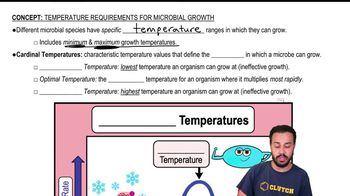
  • What are the main environmental factors that influence microbial growth?

    • Temperature
    • pH
    • Osmotic pressure
    • Radiation
    • Hydrostatic pressure
    • Gases
    • Other microbes
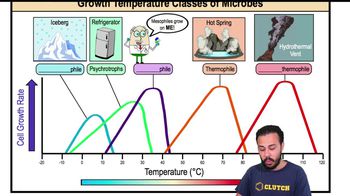
  • Define psychrophiles and their growth characteristics.

    Psychrophiles grow at 0℃ with optimum growth at 15℃. They live in deep oceans and polar regions.
  • What are psychrotrophs and their significance?

    Psychrotrophs grow at 0℃ with optimum growth between 20℃ and 30℃. They cause food spoilage in refrigerators.
  • Describe mesophiles and their typical environment.

    Mesophiles have optimum growth at 25-40℃ and include normal microbiota and pathogens of animals.
  • What defines thermophiles and hyperthermophiles?

    Thermophiles grow optimally between 50-60℃, found in hot springs. Hyperthermophiles grow above 80℃.
  • What is the typical pH range for most bacteria growth?

    Most bacteria grow best between pH 6.5 and 7.5.
  • How do molds and yeasts differ in pH preference compared to bacteria?

    Molds and yeasts grow best between pH 5 and 6, slightly more acidic than most bacteria.
  • What are obligate halophiles and where are they found?

    Obligate halophiles require high salt concentrations and are found in places like the Dead Sea and Great Salt Lake.
  • What is the difference between obligate aerobes and obligate anaerobes?

    Obligate aerobes require oxygen and can detoxify it; obligate anaerobes cannot use or detoxify oxygen.
  • What role does superoxide dismutase (SOD) play in oxygen tolerance?

    SOD catalyzes the conversion of superoxide radicals to oxygen and hydrogen peroxide, protecting cells from oxidative damage.
  • How does catalase contribute to microbial oxygen tolerance?

    Catalase converts hydrogen peroxide into water and oxygen, detoxifying harmful reactive oxygen species.
  • What is quorum sensing in biofilms?

    Quorum sensing is cell-to-cell communication via signaling chemicals (autoinducers) that regulate gene expression in bacterial communities.
  • Describe the bacterial cell cycle and reproduction method.

    Bacteria reproduce asexually by binary fission, involving DNA replication and partitioning into two daughter cells.
  • What is generation time in bacterial growth?

    Generation time is the time required for a bacterial cell to divide, ranging from 20 minutes to 24 hours.
  • Why are logarithmic scales used in bacterial growth graphs?

    Log scales simplify and standardize large ranges of cell numbers, making growth phases easier to identify.
  • What is the purpose of serial dilution in quantifying bacterial growth?

    Serial dilution reduces bacterial concentration to countable levels for estimating the number of cells in the original sample.
  • How does the spread plate method work?

    Sample is spread on solid agar with a sterile spreader; colonies grow and are counted to estimate cell numbers.
  • What is the difference between spread plate and pour plate methods?

    Spread plate spreads sample on agar surface; pour plate mixes sample with warm agar before solidifying.
  • How does fluorescence staining differentiate viable and dead bacterial cells?

    Viable cells stain green; dead cells stain red, allowing differentiation under a microscope.
  • What is turbidity measurement (OD600) used for in microbiology?

    Turbidity measures bacterial cell density indirectly by light scattering using a spectrophotometer at 600 nm wavelength.