 Indietro
Microbiology: Adaptive Immunity and Immunological Concepts
 04:57

Termini in questo insieme (60)
Immunological memory is the immune system's ability to remember a previously encountered antigen, enabling a faster and stronger response upon subsequent exposures.
APCs process and present antigens to T cells to initiate immune responses. Dendritic cells, an agranulocyte, act as professional APCs.
True. Both T-cells and B-cells require antigen presentation to become activated and elicit an immune response.
Clonal expansion is the rapid multiplication of antigen-specific lymphocytes after activation to increase the number of cells that can fight the antigen.
Memory cells provide long-term immunity by quickly recognizing and responding to previously encountered antigens.
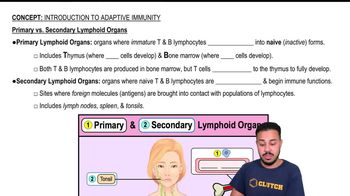
T and B cells are produced in the bone marrow. B cells mature in the bone marrow, while T cells mature in the thymus.
True. Mature T and B cells primarily reside in lymphoid tissues such as lymph nodes and the spleen.
An antigen is any molecule or molecular structure that can be recognized by the immune system and elicit an immune response.
Immunogenic refers to the ability of a substance to provoke an immune response.
A hapten is a small molecule that is not immunogenic by itself but can elicit an immune response when attached to a larger carrier molecule.
Penicillin can act as a hapten by binding to proteins and triggering allergic immune responses in some individuals.
From most to least immunogenic: proteins, polysaccharides, lipids, and haptens.
An epitope is the specific part of an antigen recognized and bound by an antibody or T-cell receptor.
Monospecific means each T or B cell recognizes and responds to only one specific antigen epitope.
T and B cells are activated by recognizing their specific antigen presented by APCs, often requiring co-stimulatory signals.
False. T helper cells are CD4+ and T cytotoxic cells are CD8+.
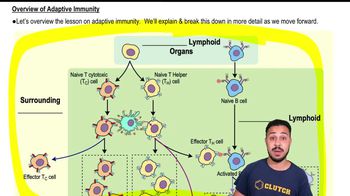
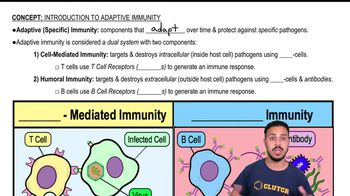
T helper cells coordinate the immune response by activating cytotoxic T cells and B cells, bridging cellular and humoral immunity.
HIV primarily destroys CD4+ T helper cells, weakening the immune system.
TH1: activates macrophages, cytotoxic T cells, and B cells; TH2: stimulates B cells for antibody production; TH17: promotes inflammation and recruits neutrophils.
Cytotoxic T cells kill infected or abnormal cells by recognizing antigens presented with MHC I proteins.
Gene shuffling generates diverse antigen receptors on T and B cells, enabling recognition of many different antigens.
Self-tolerance prevents immune cells from attacking the body’s own tissues; screening removes self-reactive cells to avoid autoimmune diseases.
MHC proteins present antigen fragments on cell surfaces for recognition by T cells, crucial for immune response and self-tolerance.
False. Only T cells use MHC recognition during self-tolerance screening; B cells do not.
Errors in self-tolerance can lead to autoimmune diseases, where the immune system attacks the body’s own tissues.
All nucleated cells have MHC I; professional APCs like dendritic cells, macrophages, and B cells have MHC II.
True. APCs express both MHC I and MHC II proteins on their surfaces.
Dendritic cells are the most active APCs in initiating adaptive immune responses.
MHC I presents intracellular antigens; MHC II presents extracellular antigens.
Proteasomes degrade intracellular proteins into peptides for presentation by MHC I molecules.
They are activated by recognizing antigen peptides presented with MHC I on infected or abnormal cells, plus co-stimulatory signals.
A phagolysosome is a vesicle formed by fusion of a phagosome and lysosome; it digests extracellular antigens for MHC II presentation.
GVHD occurs when donor T cells attack recipient tissues after transplantation due to MHC differences.
Primary signal: TCR recognition of MHC-antigen complex; secondary signal: co-stimulatory molecules from APCs.
Superantigens bypass normal antigen processing by binding directly to TCR and MHC II, causing excessive T cell activation.
They release perforin to form pores and granzymes to induce apoptosis in target cells.
T-independent activation does not require T helper cells and usually lacks long-term protection; T-dependent activation requires T helper cells and leads to memory formation.
Plasma cells are activated B cells that produce and secrete large amounts of antibodies.
True. Antibodies produced by plasma cells are also known as immunoglobulins.
Antigen binding sites are located in the variable regions at the tips of the antibody's arms.
Isotype switching changes the antibody class (e.g., IgM to IgG) to tailor the immune response without altering antigen specificity.
IgG is the most abundant antibody isotype in blood.
IgG can cross the placenta to provide passive immunity to the fetus.
IgM is the most effective antibody at activating the complement system.
IgA is found in mother’s milk as a dimer, providing mucosal immunity to infants.
IgM is produced early during the primary immune response.
IgM can exist as a pentamer in serum or monomer on B cell surfaces.
IgM is central to agglutination and precipitation due to its pentameric structure.
IgE mediates allergic reactions and defense against parasites.
IgM is made first during primary exposure; IgG dominates during secondary exposure.
Antibody titer is the concentration of specific antibodies in the blood, indicating immune response strength.
Convalescent plasma is plasma collected from recovered patients containing antibodies used for passive immunity.
Monoclonal antibodies are identical antibodies produced by cloned B cells targeting a single epitope.
Naturally acquired immunity occurs through infection or maternal transfer; artificially acquired immunity results from vaccines or antibody injections.
Active immunity involves the host producing antibodies and memory cells; passive immunity involves receiving antibodies from another source.
Naturally acquired active immunity.
Artificially acquired active immunity.
Naturally acquired passive immunity.
Artificially acquired passive immunity.
Artificially acquired passive immunity.