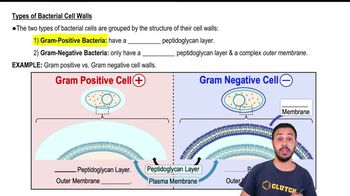
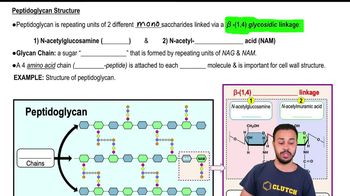
What is the primary difference in the cell wall structure between Gram-positive and Gram-negative bacteria?
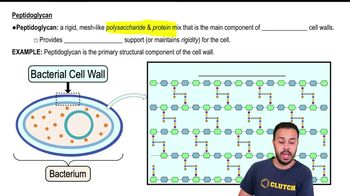
Gram-positive bacteria have a thick peptidoglycan layer and teichoic acids, while Gram-negative bacteria have a thin peptidoglycan layer and an outer membrane containing lipopolysaccharide (LPS).
What role does lipopolysaccharide (LPS) play in Gram-negative bacteria?
LPS contributes to the negative charge on the cell surface, stabilizes the outer membrane, aids in attachment and biofilm formation, acts as a permeability barrier, protects from host defenses, and can act as an endotoxin.
What are porin proteins and where are they found?
Porin proteins are channels in the outer membrane of Gram-negative bacteria that allow diffusion of small molecules into the periplasmic space.
What is the function of teichoic acids in Gram-positive bacteria?
Teichoic acids are embedded in the peptidoglycan layer and help maintain cell wall structure and contribute to the cell's negative charge.
Describe the Gram stain reaction mechanism.
Crystal violet stains all cells purple; iodine stabilizes the dye; alcohol decolorizes Gram-negative cells by removing outer membrane lipids; Gram-positive cells retain the dye due to thick peptidoglycan.
What is the periplasmic space and how does it differ between Gram-positive and Gram-negative bacteria?
The periplasmic space is the area between the plasma membrane and cell wall; it is very narrow in Gram-positive bacteria and wider in Gram-negative bacteria.
What are the main components of the bacterial flagellum?
The flagellum consists of three parts: the filament, the hook protein, and the basal body.
How does bacterial flagellar motility work?
The flagellum rotates like a propeller; counterclockwise rotation causes forward movement (run), clockwise rotation causes tumbling and change of direction.
What are the different patterns of flagella distribution on bacterial cells?
Monotrichous (single flagellum), polar (flagellum at one end), amphitrichous (flagella at both ends), lophotrichous (cluster at one or both ends), and peritrichous (flagella all over the surface).
What is chemotaxis in bacteria?
Chemotaxis is the movement of bacteria toward chemical attractants or away from repellents by altering flagellar rotation to produce longer runs or more tumbles.
What proteins form the motor of the bacterial flagellum?
The rotor includes the C ring (FliG protein) and MS ring, while the stator is composed of MotA and MotB proteins acting as an electromagnet.
What is the function of pili and fimbriae on bacterial cells?
Pili and fimbriae mediate attachment to surfaces; pili are also involved in conjugation, while fimbriae primarily aid adherence.
What is the glycocalyx and what are its components?
The glycocalyx is the outermost layer of the cell envelope, including capsules and slime layers that aid in attachment and protection.
How do capsules differ from slime layers?
Capsules are well-organized, tightly attached polysaccharide layers visible under a microscope, while slime layers are diffuse, unorganized, and easily removed.
What are S-layers and their functions?
S-layers are crystalline arrays of protein or glycoprotein that protect cells from environmental stress, maintain shape, promote adhesion, and may protect from host defenses.
What makes bacterial endospores highly resistant?
Endospores have a dehydrated core, calcium-dipicolinic acid complex, small acid-soluble DNA-binding proteins (SASPs), and protective spore coats.
What is sporulation?
Sporulation is the multistage process of endospore formation triggered by nutrient limitation, taking up to 10 hours.
Describe the process of germination in bacterial endospores.
Germination involves activation (preparation), detection of nutrients, spore swelling, rupture of the spore coat, loss of resistance, and outgrowth into a vegetative cell.
What factors are used in bacterial taxonomy?
Classification is based on size, shape, Gram type, colony morphology, presence of structures (capsules, endospores), physiological traits, and DNA sequence data.
What is the role of TonB-dependent receptors in Gram-negative bacteria?
TonB-dependent receptors are outer membrane proteins that catalyze high-affinity active transport of molecules across the outer membrane.
 Indietro
 01:58