Skip to main content
Microbiology
Il mio corso
Impara
Preparazione agli esami
AI Tutor
Guide di studio
Soluzioni per libri di testo
Flashcard
Esplora
Prova l'app
Il mio corso
Impara
Preparazione agli esami
AI Tutor
Guide di studio
Soluzioni per libri di testo
Flashcard
Esplora
Prova l'app
Indietro
Microbiology: Bacterial Growth and Physiology
Puoi toccare per girare la carta.
Why does bacterial growth decrease above the maximum growth temperature?
Puoi toccare per girare la carta.
👆
Why does bacterial growth decrease above the maximum growth temperature?
Enzymes and proteins become
denatured
, impairing cellular functions.
Avanzamenti del tracciato
I pulsanti di controllo sono stati cambiati in modalità "navigazione".
1/40
Video consigliati
08:59
Microbial Growth Curves in a Closed System
3921
views
64
rank
02:33
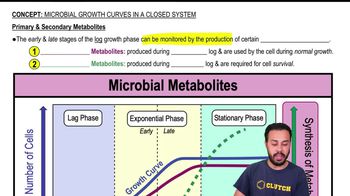
Primary & Secondary Metabolites
2738
views
35
rank
Termini in questo insieme (40)
Nascondere definizioni
Why does bacterial growth decrease above the maximum growth temperature?
Enzymes and proteins become
denatured
, impairing cellular functions.
Which bacterial growth phase shows decreasing viable cell numbers due to nutrient exhaustion and waste accumulation?
The
death phase
.
Do all microorganisms in biofilms belong to the same species?
No, biofilms often contain
multiple species
and organisms from different kingdoms.
What environment favors growth of a bacterium that grows best at pH 9.5?
An
alkaline lake
.
What is the effect of a drug that prevents FtsZ ring formation in bacteria?
Cytokinesis cannot occur
, preventing cell division.
A microorganism requiring at least 9% NaCl for growth is classified as a:
Extreme halophile
.
Which bacterial growth phase is metabolically active but shows no increase in cell number?
The
stationary phase
.
What component primarily holds a biofilm together?
The
EPS (extracellular polymeric substance) matrix
.
How can growth of a foodborne pathogen be reduced without antimicrobials?
By
reducing water availability and lowering temperature
.
Why are jams and jellies resistant to microbial spoilage?
High sugar content
reduces water availability
.
What does continued bacterial growth despite oxygen depletion indicate?
The organism may be capable of
anaerobic metabolism
.
Which bacterial growth phase occurs when a culture reaches carrying capacity?
The
stationary phase
.
Why is infection by a hyperthermophile unlikely in the human body?
Its enzymes are optimized for
much higher temperatures
than human body temperature.
How is a bacterium growing best at pH 2.5 classified?
As an
acidophile
.
During which bacterial growth phase do patients often first develop symptoms?
During the
log (exponential) phase
.
A bacterium growing only at the top of a thioglycolate tube is classified as:
An
obligate aerobe
.
Which group likely causes growth of pathogens in refrigerated foods at 4°C?
Psychrotrophs
.
A bacterium growing evenly throughout a thioglycolate tube without using oxygen is:
An
aerotolerant anaerobe
.
What characteristic contributes most to biofilm resistance?
The
protective EPS matrix
.
What process occurs when a bacterium placed in concentrated brine immediately loses water?
Plasmolysis
.
Why are obligate anaerobes often harmed by oxygen?
They lack enzymes that
detoxify reactive oxygen species
.
A microorganism growing optimally at 4°C and not above 20°C is a:
Psychrophile
.
What explains recurrent catheter-associated infections?
Development of
biofilms on the catheter surface
.
A bacterium growing at 4°C, 25°C, and 37°C is likely a:
Psychrotroph
, capable of growth during refrigeration.
Successful antibiotic treatment should push bacteria into which phase?
The
death phase
.
A chronic infection with persistent low-level symptoms resembles which bacterial phase?
The
stationary phase
.
Which process is affected if a mutant bacterium lacks functional Par proteins?
Chromosome segregation
.
What effect does a drug interfering with quorum sensing have?
It causes
reduced community coordination and virulence
.
If a bacterial species doubles every 30 minutes, how many cells after 2 hours starting from 1,000?
16,000 cells.
Most effective strategy to prevent biofilm formation on medical implants?
Prevent initial bacterial attachment
.
A pathogen synthesizing enzymes but not increasing in number is in which phase?
The
lag phase
.
During which phase are secondary metabolites like antibiotics commonly produced?
The
stationary phase
.
Why can strict anaerobes survive within dental plaque?
Surface organisms consume oxygen, creating
anaerobic niches
.
Why do generation times vary between bacterial species?
Generation time varies among species and environmental conditions.
A bacterial community attached to a surface with EPS and quorum sensing is a:
Biofilm
.
An organism growing with oxygen but switching to anaerobic respiration is a:
Facultative anaerobe
.
Why are most human pathogens neutrophiles?
Because human body fluids are near
neutral pH
.
How does Helicobacter pylori survive stomach acidity?
It produces
urease
that raises local pH.
A drug inhibiting Fts proteins affects:
Cell division
.
During which phase are bacteria most susceptible to antibiotics?
During the
log (exponential) phase
.
 IndietroIndietro
 08:59
08:59