Skip to main content
Microbiology
Il mio corso
Impara
Preparazione agli esami
AI Tutor
Guide di studio
Soluzioni per libri di testo
Flashcard
Esplora
Prova l'app
Il mio corso
Impara
Preparazione agli esami
AI Tutor
Guide di studio
Soluzioni per libri di testo
Flashcard
Esplora
Prova l'app
Indietro
Microbiology: Cell Membranes, Lipids, Proteins, and Transport
Puoi toccare per girare la carta.
Structure of a phospholipid
Puoi toccare per girare la carta.
👆
Structure of a phospholipid
Phospholipids have a
hydrophilic head
(phosphate group and glycerol) and two
hydrophobic tails
(fatty acids, saturated or unsaturated).
Avanzamenti del tracciato
I pulsanti di controllo sono stati cambiati in modalità "navigazione".
1/29
Video consigliati
03:31
Steroids & Waxes
18370
views
208
rank
04:19
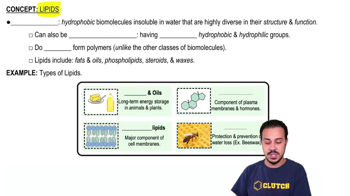
Lipids
24666
views
418
rank
06:59
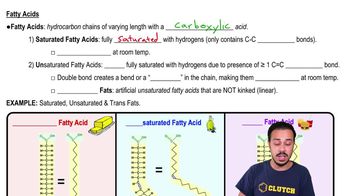
Fatty Acids
21857
views
327
rank
Termini in questo insieme (29)
Nascondere definizioni
Structure of a phospholipid
Phospholipids have a
hydrophilic head
(phosphate group and glycerol) and two
hydrophobic tails
(fatty acids, saturated or unsaturated).
Triacylglycerol formation
Three fatty acid chains bind to glycerol by
dehydration synthesis
, forming triglycerides and releasing 3 water molecules.
Lipid bilayer organization
Phospholipids arrange into bilayers with
polar heads facing outward
and
nonpolar tails inward
, forming membranes, liposomes, or micelles.
Fluid mosaic model of membranes
Membranes are viscous like olive oil, with proteins and phospholipids moving laterally and rotating, allowing self-sealing and dynamic function.
Amino acid basic structure
Amino acids have an
amine group (NH2)
, a
carboxyl group (COOH)
, a central carbon, and a variable
R group
.
Types of amino acids
Amino acids differ by their
R groups
, which determine properties like polarity, charge, and size.
Protein primary structure
The
sequence of amino acids
linked by peptide bonds forms the primary structure of a protein.
Protein secondary structure
Local folding into
alpha-helices
and
beta-pleated sheets
stabilized by hydrogen bonds.
Protein tertiary structure
Three-dimensional folding stabilized by hydrophobic interactions, ionic bonds, hydrogen bonds, and disulfide bridges.
Protein quaternary structure
Assembly of multiple polypeptide subunits into a functional protein complex.
Beta-barrel proteins
Proteins with beta-sheet strands forming a barrel shape, often found in outer membranes as pores or transporters.
Membrane components
Cell membranes contain phospholipids, proteins (integral and peripheral), lipoproteins, and lipopolysaccharides.
Cholesterol in membranes
Cholesterol is a complex lipid that stabilizes membrane fluidity in eukaryotic cells.
Passive transport: simple diffusion
Movement of solutes from high to low concentration without energy or transport proteins.
Passive transport: facilitated diffusion
Movement of ions or molecules across membranes via specific transporter proteins along the concentration gradient.
Osmosis
Net movement of water across a selectively permeable membrane from high water concentration (low solute) to low water concentration (high solute).
Active transport
Transport of substances against their concentration gradient using transporter proteins and ATP energy.
Group translocation
Active transport where the substance is chemically modified during transport, requiring phosphoenolpyruvic acid (PEP).
Chromosome in prokaryotes
Single circular double-stranded DNA molecule located in the nucleoid, not enclosed by a nuclear membrane.
Plasmids
Small extrachromosomal DNA circles carrying non-essential genes like antibiotic resistance; replicate independently and can transfer between bacteria.
RNA structure and function
Single-stranded ribonucleotides with ribose sugar; involved mainly in protein synthesis and regulation; less stable than DNA.
Prokaryotic ribosomes
70S ribosomes composed of 50S and 30S subunits, responsible for protein synthesis.
Inclusion bodies in prokaryotes
Storage compartments for nutrients like glycogen, sulfur, lipids, and gas.
Endospores
Dormant, resistant cells formed by some bacteria to survive harsh conditions; not reproductive.
Eukaryotic flagella and cilia
Locomotion structures made of microtubules in a 9+2 arrangement; flagella are longer and fewer, cilia are shorter and numerous.
Eukaryotic cell membrane differences
Contains sterols and carbohydrates for cell recognition; similar phospholipid bilayer structure to prokaryotes.
Endocytosis types
Phagocytosis (engulf particles), pinocytosis (ingest fluid), and receptor-mediated endocytosis (specific uptake).
Mitochondria features
Double membrane organelle with cristae; site of cellular respiration; contains 70S ribosomes and circular DNA.
Chloroplasts
Organelles for photosynthesis containing thylakoids with chlorophyll, 70S ribosomes, and circular DNA.
 IndietroIndietro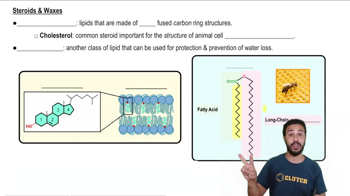
 03:31
03:31