Skip to main content
Microbiology
Il mio corso
Impara
Preparazione agli esami
AI Tutor
Guide di studio
Soluzioni per libri di testo
Flashcard
Esplora
Prova l'app
Il mio corso
Impara
Preparazione agli esami
AI Tutor
Guide di studio
Soluzioni per libri di testo
Flashcard
Esplora
Prova l'app
Indietro
Microbiology Chapter 4 Deck 1
Puoi toccare per girare la carta.
What is a psychrophile?
Puoi toccare per girare la carta.
👆
What is a psychrophile?
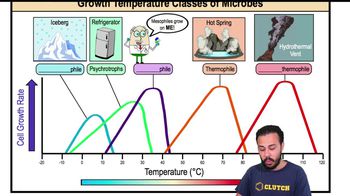
A microbe with an optimum growth temperature ≤15°C.
Avanzamenti del tracciato
I pulsanti di controllo sono stati cambiati in modalità "navigazione".
1/50
Video consigliati
04:16
Temperature Requirements for Microbial Growth
3650
views
50
rank
04:56
Classification of Microbes by Growth Temperature
3396
views
45
rank
01:59
How to Memorize the Classification of Microbes by Growth Temperatures
3033
views
33
rank
Termini in questo insieme (50)
Nascondere definizioni
What is a psychrophile?
A microbe with an optimum growth temperature ≤15°C.
What is a defined medium?
A medium whose exact chemical composition is known.
What does a bactericidal agent do?
Kills cells without causing lysis.
What is the lag phase?
Cells adapt to new conditions before rapid division begins.
What is an acidophile?
A microbe that grows best at pH below 5.5.
What does a microscopic cell count measure?
Total cells present, both living and dead.
What is a biofilm?
Cells in a polysaccharide matrix attached to a surface.
What is sterilization?
Killing all microbial cells.
What is generation time?
Time required for a microbial population to double.
What is a halophile?
A microbe with a specific requirement for NaCl.
What are macronutrients?
Nutrients required in large amounts.
What does UV radiation damage?
DNA.
What is a batch culture?
A closed-system microbial culture with a fixed volume.
What is a facultative aerobe?
Grows with or without O₂ but grows better with O₂.
What is a complex medium?
A medium containing digests of microbial, animal, or plant products.
What happens to cells in a hypertonic solution?
Water flows out of the cells.
What are the four phases of batch growth?
Lag, exponential, stationary, and decline/death.
What does an autoclave use to sterilize?
Steam under pressure at high temperature.
What is a xerophile?
A microbe able to grow in very dry environments.
What is the first step of binary fission?
The DNA is copied.
What is a selective medium?
A medium that inhibits some microbes but allows others to grow.
What is the optimum cardinal temperature?
Temperature at which growth is fastest.
What are growth factors?
Organic micronutrients, such as vitamins.
What is a bacteriostatic agent?
An agent that inhibits bacterial growth.
What is planktonic growth?
Growth of free-floating or free-swimming cells.
What is osmosis?
Water movement from low to high solute concentration.
What is the purpose of a viable cell count?
To measure living, reproducing cells.
What is a thermophile?
A microbe with an optimum growth temperature of 45–80°C.
What happens during exponential phase?
Cells double at regular intervals.
What does a differential medium contain?
An indicator that detects metabolic reactions during growth.
What are CHNOPS?
Carbon, hydrogen, nitrogen, oxygen, phosphorus, and sulfur.
What is pasteurization?
Heat treatment that significantly reduces microbes in heat-sensitive liquids.
What is a microaerophile?
A microbe requiring O₂ below atmospheric levels.
What is the minimum cardinal temperature?
Lowest temperature at which a microbe can grow.
What is a colony-forming unit (CFU)?
A unit used to report viable microbial counts.
What does catalase help eliminate?
Toxic oxygen intermediates.
What is a chemostat?
A continuous-culture device where fresh and spent media flow at equal rates.
What happens to cells in an isotonic solution?
No net water movement occurs.
What is a sanitizer?
A less-harsh agent that reduces microbial numbers without sterilizing.
What are micronutrients?
Nutrients required in minute amounts.
What is cryptic growth?
Cells reuse resources from dead cells to continue growth.
What is an obligate anaerobe?
A microbe inhibited or killed by oxygen.
What does optical density estimate?
Microbial cell numbers based on turbidity.
What is a hyperthermophile?
A microbe with an optimum growth temperature above 80°C.
What is the purpose of compatible solutes?
Maintain positive water balance during osmotic stress.
What is the stationary phase?
Cell division equals cell death, so population growth is zero.
What is disinfection?
Killing or severely inhibiting pathogens, but not necessarily all microbes.
What is the formula for generation time?
g = t ÷ n, where g is generation time, t is time, and n is number of generations.
What is sessile growth?
Growth of cells attached to a surface.
What is an antiseptic?
An antimicrobial safe enough for use on living tissue.
 IndietroIndietro
 04:16
04:16