 Indietro
Microbiology: Chemical Principles and Biological Molecules
 02:13
02:13
Termini in questo insieme (34)
An atom is the smallest unit of a chemical element that retains the element's properties.
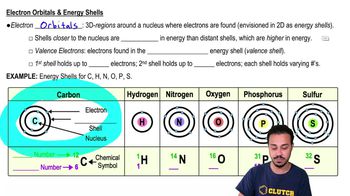
Atoms contain protons (positive), neutrons (no charge), and electrons (negative).
The atomic number is the number of protons in an atom's nucleus and determines the element's identity.
Atomic mass is approximately the total number of protons and neutrons in an atom.
Isotopes are atoms of the same element with the same number of protons but different numbers of neutrons and atomic masses.
Valence electrons are electrons in the outermost shell that determine chemical properties and reactivity.
A molecule is two or more atoms joined chemically; a compound contains at least two different elements.
A chemical bond is an attractive force holding atoms together to achieve stable electron configurations.
Ionic bonds form by electron transfer between atoms, creating oppositely charged ions that attract.
Covalent bonds form when atoms share pairs of electrons; they are stronger than ionic bonds.
Hydrogen bonds are weak attractions involving a hydrogen covalently bonded to O or N, attracted to another O or N.
Molecular mass is the sum of the atomic masses of all atoms in a molecule.
Endergonic reactions require energy input; exergonic reactions release energy.
Synthesis builds molecules; decomposition breaks molecules down; exchange swaps parts between molecules.
Water is abundant, polar, an excellent solvent, participates in hydrolysis, and buffers temperature in cells.
Acids dissociate to release H⁺ ions; bases dissociate to release OH⁻ ions or reduce H⁺ concentration.
pH measures H⁺ ion concentration: below 7 acidic, 7 neutral, above 7 basic/alkaline.
Buffers maintain stable pH, essential for cellular chemical reactions.
Organic compounds contain carbon and hydrogen, mostly held by covalent bonds.
Carbon can form up to four bonds, allowing formation of chains and complex structures in biological molecules.
Functional groups are specific atom groups attached to organic molecules that determine chemical properties.
Macromolecules are large molecules made of monomers: carbohydrates, lipids, proteins, nucleic acids.
Dehydration synthesis joins monomers into polymers by removing water.
Hydrolysis breaks polymers into smaller molecules by adding water.
Carbohydrates contain C, H, O with H:O ratio ~2:1; important for energy, storage, and structure.
Monosaccharides are simple sugars with 3–7 carbons, e.g., glucose and fructose.
Saturated lipids have no C=C double bonds; unsaturated lipids have one or more double bonds.
Phospholipids contain glycerol, two fatty acids, and a phosphate group; major plasma membrane components.
Amino acids are protein building blocks containing C, H, O, N, and sometimes S; 20 common types exist.
Primary: amino acid sequence; Secondary: helices and sheets; Tertiary: 3D shape; Quaternary: multiple polypeptides.
Nucleotides consist of a pentose sugar, phosphate group, and nitrogenous base; building blocks of nucleic acids.
DNA has deoxyribose, thymine, usually double-stranded; RNA has ribose, uracil, usually single-stranded.
ATP is the cell's main energy carrier, composed of adenosine and three phosphate groups.
Hydrolysis of ATP's terminal phosphate releases energy, producing ADP and inorganic phosphate.