Indietro

Microbiology: Eukaryotes - Fungi, Algae, Protozoa, and Helminths

I pulsanti di controllo sono stati cambiati in modalità "navigazione".
1/28
  • What are the main types of fungi?

    Molds (multicellular, filamentous), yeasts (unicellular, non-filamentous), and fleshy fungi (mushrooms).
  • What are the growth requirements of fungi?

    Fungi are chemoheterotrophs, prefer acidic pH (~5), mostly aerobic, resist osmotic pressure better than bacteria, need less moisture, and metabolize complex carbohydrates.
  • Describe the structure of mold hyphae.

    Hyphae are long filaments; vegetative hyphae obtain nutrients, reproductive hyphae grow upward and support spores. They can be septate (with crosswalls) or coenocytic (non-septate).
  • What is a mycelium?

    A mass of hyphae forming the body of a mold.
  • What are asexual spores in fungi?

    Spores produced by one organism, genetically identical to the parent. Examples: sporangiospores (enclosed in sacs) and conidiospores (chains at hyphae ends).
  • What are sexual spores in fungi?

    Spores formed by fusion of nuclei from two mating strains, containing genetic material from both parents; less common than asexual spores.
  • Name some important effects of molds.

    Agricultural damage (e.g., chestnut blight), biotechnology (penicillin, taxol), food production, and ecological benefits.
  • What is a mycosis?

    A fungal infection; often chronic and difficult to treat due to fungi being eukaryotes.
  • List the five classifications of mycoses.

    Superficial, subcutaneous, cutaneous, opportunistic, and systemic mycoses.
  • What characterizes superficial mycoses?

    Localized infections along hair shafts and epidermal cells, common in tropical climates.
  • What causes subcutaneous mycoses?

    Direct implantation of spores or mycelia into puncture wounds, usually from soil fungi (e.g., sporotrichosis).
  • What are cutaneous mycoses?

    Infections of epidermis, hair, and nails caused by dermatophytes that secrete keratinase (e.g., ringworm, athlete's foot).
  • What defines opportunistic mycoses?

    Infections by normal flora fungi that become pathogenic in immunocompromised hosts (e.g., Pneumocystis carinii in AIDS).
  • What are systemic mycoses?

    Deep tissue infections often caused by soil fungi; transmitted by inhalation of spores (e.g., histoplasmosis).
  • What are key characteristics of yeasts?

    Unicellular, oval-shaped, facultative anaerobes that reproduce by budding.
  • What is the role of yeasts in industry and disease?

    Used in food production (brewing, baking), biotechnology (vaccines), and can cause opportunistic infections like candidiasis.
  • What are algae and their ecological role?

    Simple photoautotrophs, unicellular or multicellular, producing oxygen via photosynthesis and forming the base of aquatic food chains.
  • Name three types of algae and their uses or features.

    Brown algae produce algin; red algae provide agar and some produce toxins; green algae have cellulose walls similar to plants.
  • What are pathogenic algae examples and their effects?

    Diatoms produce domoic acid causing neurological disease; dinoflagellates produce toxins causing paralytic shellfish poisoning and red tides.
  • What are protozoans?

    Single-celled chemoheterotrophs, some parasitic, found in water and soil, with diverse motility and life cycles.
  • Describe the Amoebozoa group of protozoans.

    Move by pseudopods; includes Entamoeba histolytica causing amoebic dysentery transmitted by cyst ingestion.
  • What is Giardia lamblia and its symptoms?

    A flagellated protozoan causing prolonged diarrhea, nausea, and cramps; detected by the string test.
  • What disease does Trichomonas vaginalis cause?

    Urinary and genital tract infections with symptoms like itching, discharge, and redness; transmitted possibly by fomites.
  • What are Apicomplexans and examples?

    Non-motile intracellular parasites with complex life cycles; includes Plasmodium (malaria) and Toxoplasma gondii (toxoplasmosis).
  • What is the role of arthropods in disease?

    Arthropods are vectors transmitting diseases like malaria, Lyme disease, and West Nile virus.
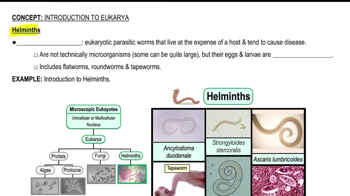
  • What are helminths?

    Multicellular parasitic worms with reduced organ systems; include flatworms (trematodes, cestodes) and roundworms (nematodes).
  • Name some important flatworms and their characteristics.

    Trematodes (flukes) have suckers and live in organs; cestodes (tapeworms) are intestinal parasites acquired by eating undercooked meat or fish.
  • What are nematodes and examples?

    Roundworms like Enterobius vermicularis (pinworms), Ascaris lumbricoides, and Necator americanus (hookworms) causing various infections.