Indietro

Microbiology Exam 3 Study Guide Flashcards

I pulsanti di controllo sono stati cambiati in modalità "navigazione".
1/48
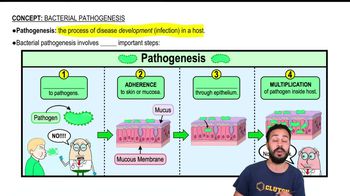
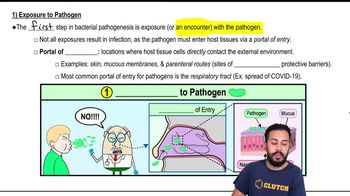
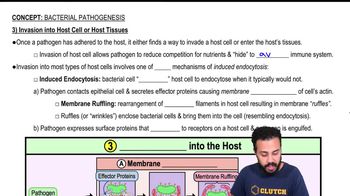
  • What are the five steps of microbial pathogenicity?

    Enter, stick, evade, damage, exit. Each step involves specific virulence factors that help the pathogen infect and spread.
  • What does ID₅₀ indicate about a pathogen?

    ID₅₀ is the infectious dose that causes infection in 50% of exposed hosts, indicating pathogen infectivity.
  • What does LD₅₀ indicate about a toxin or pathogen?

    LD₅₀ is the lethal dose that kills 50% of exposed hosts, indicating toxin or pathogen potency.
  • How do adhesins help pathogens?

    Adhesins allow pathogens to attach to host cells, facilitating colonization and infection.
  • What role do capsules play in pathogenicity?

    Capsules protect pathogens from phagocytosis, helping them evade the host immune system.
  • How do exoenzymes assist pathogens?

    Exoenzymes break down host tissues and barriers, aiding pathogen invasion and spread.
  • What is the function of IgA proteases in pathogens?

    IgA proteases degrade IgA antibodies, helping pathogens evade mucosal immune defenses.
  • How does antigenic variation benefit pathogens?

    Antigenic variation allows pathogens to change surface proteins, avoiding immune detection.
  • What are siderophores and their role in infection?

    Siderophores scavenge iron from the host, which is essential for pathogen growth.
  • Compare exotoxins and endotoxins.

    Exotoxins are secreted proteins from mostly Gram-positive bacteria causing specific effects; endotoxins are lipopolysaccharides from Gram-negative bacteria causing general inflammation. Killing Gram-negative bacteria can release endotoxin, worsening symptoms.
  • How can you distinguish intoxication from infection?

    Intoxication results from ingesting toxins; infection involves pathogen growth in the host.
  • How do superantigens cause harm?

    Superantigens overstimulate the immune system, causing excessive inflammation and tissue damage.
  • How do plasmids and lysogeny turn harmless strains into pathogens?

    Plasmids and lysogenic phages can carry virulence genes that convert non-pathogenic strains into pathogens.
  • What is the difference between incidence and prevalence?

    Incidence is the number of new cases in a time period; prevalence is the total number of cases at a given time.
  • Classify diseases as sporadic, endemic, epidemic, or pandemic.

    Sporadic: rare cases; endemic: constant presence; epidemic: sudden increase; pandemic: worldwide spread.
  • What are communicable, contagious, and noncommunicable diseases?

    Communicable: spread between hosts; contagious: easily spread; noncommunicable: not spread between hosts.
  • Name the main transmission routes of infectious diseases.

    Contact (direct, indirect, droplet), vehicle (air, water, food), vector (mechanical, biological).
  • What does an epidemic curve show?

    It shows the number of cases over time and can indicate point-source, continuous common-source, or propagated spread.
  • How is R₀ used to predict outbreak growth?

    If > 1, the outbreak grows; if < 1, it declines.
  • What is the herd immunity threshold formula?

    Herd immunity threshold = \(1 - \frac{1}{R_0}\), the proportion needing immunity to stop spread.
  • Distinguish infection from disease.

    Infection is pathogen colonization; disease is damage or symptoms caused by infection.
  • What is the difference between resident and transient microbiota?

    Resident microbiota permanently colonize; transient microbiota temporarily present.
  • Why is 16S rRNA sequencing used to identify gut bacteria?

    Because many gut bacteria are hard to culture, 16S rRNA sequencing identifies them by genetic signature.
  • What is microbial antagonism?

    Resident microbes inhibit pathogen growth by competing for resources and producing inhibitory substances.
  • What happens when antibiotics remove microbial antagonism?

    It can lead to superinfections, like Clostridioides difficile overgrowth.
  • How do opportunistic pathogens cause disease?

    They cause disease when in the wrong place, in a weakened host, or when competitors are removed.
  • Why does fecal microbiota transplant (FMT) work?

    FMT restores healthy microbiota, reestablishing microbial antagonism and preventing pathogen overgrowth.
  • Name physical and chemical barriers of innate immunity.

    Skin, mucus, cilia, lysozyme, stomach acid prevent microbial entry and growth.
  • What are the four signs of inflammation and their causes?

    Redness, heat, swelling, pain caused by increased blood flow, vascular permeability, and immune cell activity.
  • What roles do neutrophils and macrophages play in inflammation?

    Neutrophils act early to phagocytose microbes; macrophages arrive later for cleanup and repair.
  • How do Toll-like receptors (TLRs) detect microbes?

    TLRs recognize microbial molecules (PAMPs) and trigger immune responses.
  • What are the three outcomes of complement activation?

    Opsonization, inflammation, and membrane attack complex (lysis).
  • How do interferons protect neighboring cells?

    Interferons induce antiviral states in nearby cells, inhibiting viral replication.
  • Compare humoral and cellular immunity.

    Humoral immunity uses B cells and antibodies against extracellular threats; cellular immunity uses T cells against intracellular pathogens.
  • Which cells display MHC I and MHC II, and which T cells recognize them?

    All nucleated cells display MHC I recognized by CD8 T cells; antigen-presenting cells display MHC II recognized by CD4 T cells.
  • What is clonal selection in B cell activation?

    B cells with receptors matching antigen proliferate and differentiate into plasma and memory cells.
  • What functions do antibodies perform?

    Antibodies neutralize pathogens, opsonize for phagocytosis, cause agglutination, activate complement, and mediate ADCC.
  • Why do T cells need two signals for activation?

    To ensure specificity and prevent autoimmunity, T cells require antigen recognition plus co-stimulation.
  • What are the four types of acquired immunity?

    Natural active, natural passive, artificial active, artificial passive immunity.
  • What is selective toxicity in antimicrobial drugs?

    Drugs target features unique to microbes to kill or inhibit them without harming the host.
  • Why are antifungal and antiviral drugs harder to develop?

    Because fungi and viruses share many features with host cells, making selective targeting difficult.
  • What are the five target types of antimicrobial drugs?

    Cell wall, protein synthesis, nucleic acid synthesis, metabolic pathways, and cell membrane.
  • Difference between bactericidal and bacteriostatic drugs?

    Bactericidal kill bacteria; bacteriostatic inhibit growth.
  • What is the difference between narrow and broad spectrum antibiotics?

    Narrow spectrum target specific bacteria; broad spectrum target many types.
  • How to interpret Kirby-Bauer and MIC results?

    Determine if bacteria are susceptible, intermediate, or resistant to a drug to predict treatment success.
  • What are the four mechanisms of antibiotic resistance?

    Enzymatic degradation, target modification, efflux pumps, reduced permeability.
  • How does antibiotic use select for resistant cells?

    Antibiotics kill susceptible bacteria, allowing resistant ones to survive and multiply.
  • What strategies slow antibiotic resistance?

    Proper use, combination therapy, limiting use, and developing new drugs.