 Indietro
Microbiology: Genetic Transfer and Recombinant DNA Technology
 03:13

Termini in questo insieme (23)
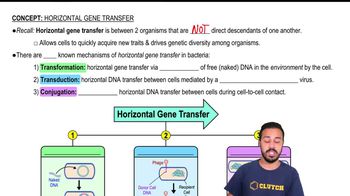
Transformation is the uptake of naked DNA from the environment by a bacterial cell, leading to genetic change.
Naked DNA refers to DNA that is free in the environment, not enclosed within a cell or virus.
Competence is the ability of a bacterial cell to take up naked DNA during transformation.
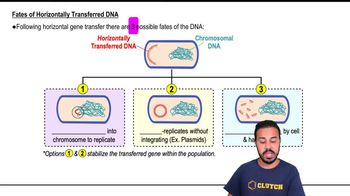
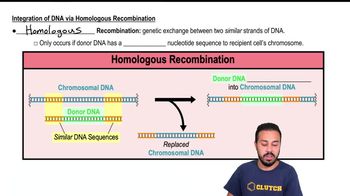
Recombination is the process where genetic material is rearranged or exchanged between DNA molecules, often after transformation or conjugation.
Transduction is the transfer of bacterial DNA from one cell to another via a bacteriophage.
A lytic bacteriophage infects a bacterium, replicates, and causes cell lysis to release new phage particles.
A lysogenic bacteriophage integrates its genome into the host DNA, forming a prophage and replicating with the host without immediate lysis.
A lysogen is a bacterial cell that carries a prophage integrated into its genome.
A prophage is the dormant form of a bacteriophage genome integrated into the bacterial chromosome during lysogeny.
Specialized transduction occurs when a prophage excises incorrectly, carrying adjacent bacterial genes to a new host.
Generalized transduction happens when a lytic phage accidentally packages random bacterial DNA and transfers it to another cell.
Conjugation is the direct transfer of DNA between bacterial cells via a pilus, often involving plasmids.
The F plasmid is a fertility plasmid that enables bacteria to form a pilus and transfer DNA during conjugation.
Hfr (high frequency recombination) cells have the F plasmid integrated into their chromosome, allowing transfer of chromosomal genes during conjugation.
An F’ plasmid is an F plasmid that carries some chromosomal genes excised from the host genome.
F+ cells contain the F plasmid and can donate DNA; F- cells lack it and are recipients in conjugation.
Gene fusion is the joining of two genes or gene segments to create a hybrid gene with new functions.
A hybridoma is a hybrid cell created by fusing a specific antibody-producing B cell with a myeloma cell, used to produce monoclonal antibodies.
PCR (polymerase chain reaction) is a technique to amplify specific DNA sequences exponentially using primers and DNA polymerase.
Recombinant DNA technology involves combining DNA from different sources to create new genetic combinations for research or applications.
Restriction endonucleases are enzymes that cut DNA at specific sequences called restriction sites.
Restriction sites are specific DNA sequences recognized and cut by restriction endonucleases.
Selective media are growth media designed to favor the growth of certain microbes while inhibiting others.