 Indietro
Microbiology: Immune System and Defenses
 05:52

Termini in questo insieme (30)
Self-tolerance is the immune system's ability to recognize and not attack the body’s own cells and molecules.
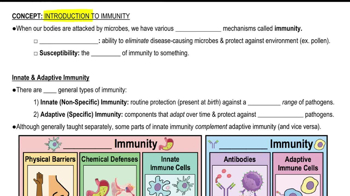
An immune person can resist infection due to prior exposure or immunity, while a susceptible person lacks immunity and can be infected.
Both provide defense against pathogens, involve leukocytes, and use chemical signals like cytokines.
Innate immunity is rapid and nonspecific; adaptive immunity is slower but specific and has memory; innate has no memory, adaptive does.
Normal microbiota competes with pathogens and helps train the immune system, supporting immune function.
The hypothesis that reduced exposure to microbes in early life leads to increased allergies and autoimmune diseases.
To prevent pathogens from entering the body by providing physical, chemical, and mechanical barriers.
Skin, rinsing action of tears, flushing action of urine, mucus/cilia trapping and sweeping action, earwax.
Stomach acid, lysozyme in tears/mucus/saliva/breast milk, antimicrobial peptides like defensins.
To trap inhaled particles in mucus and move them out of the respiratory tract via cilia movement.
Lysozyme breaks down bacterial cell walls by hydrolyzing peptidoglycan, killing bacteria.
AMPs disrupt microbial membranes, killing bacteria, fungi, and viruses.
Defensins are AMPs that insert into microbial membranes causing pore formation and cell death.
The skin acts as the primary physical barrier preventing pathogen entry.
Multiple layers of tightly packed cells, keratinized surface, dryness, and shedding of dead cells.
A network of vessels and tissues that returns fluid to blood and supports immune cell transport and surveillance.
Plasma is the liquid component of blood containing water, proteins, nutrients, and waste products.
Edema is swelling caused by excess fluid accumulation in tissues.
Lymph is fluid collected from tissues, transported by lymphatic vessels, and filtered by lymph nodes to remove pathogens.
Primary: bone marrow, thymus; Secondary: lymph nodes, spleen, tonsils, adenoids, GALT, Peyer’s patches.
T cell precursors are made in bone marrow and mature in the thymus.
B cell precursors are made and mature in the bone marrow.
Filter lymph to trap pathogens and provide sites for immune cell activation.
Swelling is due to immune cell proliferation and accumulation fighting infection.
Filters blood, removes old red blood cells, and helps mount immune responses to blood-borne pathogens.
In the small intestine, part of gut-associated lymphoid tissue (GALT).
Neutrophils, eosinophils, basophils, and mast cells.
Lymphocytes (T cells, B cells, NK cells) and monocytes.
It identifies changes in proportions of leukocyte types, indicating infection or immune status.
An increase in the total number of white blood cells, often due to infection.