 Indietro
Microbiology: Infectious Diseases and Epidemiology
 04:16
04:16
Termini in questo insieme (37)
John Snow is considered one of the first modern epidemiologists for tracing the source of a cholera outbreak in London, demonstrating disease transmission via contaminated water.
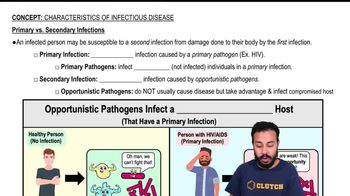
A true pathogen causes disease in healthy hosts, while an opportunistic pathogen causes disease only in immunocompromised or weakened hosts.
A host is an organism that harbors a pathogen and provides it with nutrients and a suitable environment for growth.
Sporadic infections occur irregularly and infrequently, while endemic infections are constantly present in a population or region.
An epidemic is a sudden increase in disease cases in a specific area, while a pandemic is an epidemic that spreads across multiple countries or continents.
SARS-CoV-2 caused a pandemic because it spread globally across many countries.
Emerging pathogens are newly identified or increasing in incidence, while reemerging pathogens are known pathogens that have reappeared after a decline.
A zoonotic disease is an infection transmitted from animals to humans.
COVID-19 is a zoonotic disease because it likely spread from bats to humans.
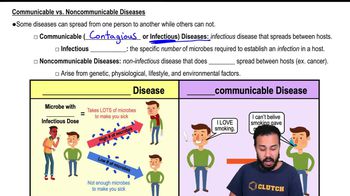
Communicable diseases can be transmitted between hosts, while noncommunicable diseases cannot be spread from person to person.
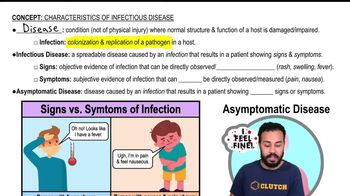
Signs are objective evidence of disease observed by others; symptoms are subjective feelings reported by the patient.
Signs: fever, rash, white blood cells in urine.
Symptoms: nausea, fatigue, malaise.
Koch’s postulates establish criteria to link a specific microorganism to a specific disease.
No, because some pathogens cannot be cultured independently or cause disease only in humans, making the postulates difficult to fulfill.
They require living host cells to replicate and cannot grow on artificial media alone.
A reservoir is the natural habitat where a pathogen normally lives and multiplies.
The source is the individual or object from which a pathogen is directly acquired by a host.
Endogenous sources originate from within the host; exogenous sources come from outside the host.
It is direct transmission because the vector directly transfers the pathogen to the host.
Vertical transmission is the passage of a pathogen from mother to offspring, e.g., HIV in utero or during birth.
Airborne transmission occurs when pathogens are spread via aerosols that remain suspended in air and are inhaled by a host.
A fomite is an inanimate object that can carry and transmit pathogens.
A vector is a living organism that transmits pathogens. Biological vectors support pathogen development; mechanical vectors only carry pathogens externally.
Infectivity is the ability to infect a host; pathogenicity is the ability to cause disease; virulence is the degree of damage caused.
Incubation, prodromal, illness, decline, and convalescence stages describe disease progression from infection to recovery.
Transmission can occur during the prodromal, illness, and sometimes convalescence stages.
Clinical cases show symptoms; subclinical cases are asymptomatic but infected.
Chronic carriers harbor and transmit pathogens long-term; asymptomatic carriers show no symptoms but can still spread disease.
To identify the cause of disease and to control or prevent its spread.
Host, agent, and environment are the three parameters influencing disease occurrence.
Quarantine is the restriction of movement of healthy individuals exposed to a contagious disease to prevent spread.
Morbidity is the rate of disease in a population; prevalence rate is total cases at a time; incidence rate is new cases over a period.
HAI stands for healthcare-associated infection, also called nosocomial infection.
Contaminated medical devices and healthcare workers' hands are common sources.
Proper hand hygiene is a simple and effective way to prevent healthcare-associated infections.
Disease eradication is the complete and permanent worldwide reduction to zero new cases of a disease.
Typically, around 70-95% vaccination coverage is needed depending on the disease.