 Indietro
Microbiology Key Concepts and Definitions
 06:17
06:17
Termini in questo insieme (29)
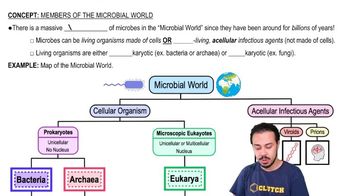
Unicellular prokaryotes with cell walls generally containing peptidoglycan.
Unicellular prokaryotes whose cell walls do not contain peptidoglycan.
Eukaryotic organisms; molds are multicellular filaments, yeasts are unicellular.
Single-celled eukaryotes that often move by pseudopods, cilia, or flagella.
Non-cellular entities that infect cellular hosts and are important in microbiology.
Allowed air in but trapped dust, preventing microbial contamination and disproving spontaneous generation.
- Agent found in diseased but not healthy hosts.
- Agent isolated and grown in pure culture.
- Agent causes disease in healthy host.
- Agent re-isolated from experimentally infected host.
Metabolic process of synthesis where smaller molecules form larger ones, requiring energy.
Metabolic process of decomposition where large molecules break down, releasing energy.
Most abundant substance in organisms; excellent solvent; liquid over wide temperatures; absorbs heat; participates in reactions.
Hydrophobic macromolecules including fats, phospholipids, waxes, and steroids; phospholipids form membranes.
Polymers of amino acids joined by peptide bonds; functions include structure, catalysis, regulation, transport, defense, and offense.
Building blocks of nucleic acids; composed of phosphate, pentose sugar, and nitrogenous base.
C–G pairs form 3 hydrogen bonds; A–T pairs form 2 hydrogen bonds; DNA strands are complementary and antiparallel.
Prokaryotes lack nucleus and membrane-bound organelles; eukaryotes have both and are larger in size.
Organized glycocalyx firmly attached; helps bacteria avoid host immune recognition.
Provides bacterial movement via rotation of filament, hook, and basal body.
Gram-positive have thick peptidoglycan and teichoic acids; Gram-negative have thin peptidoglycan and outer membrane with LPS.
Component of LPS in Gram-negative bacteria; can cause fever, inflammation, shock, and clotting.
Survival structures formed by some bacteria; resistant to heat, radiation, and chemicals; not reproductive.
Ability to distinguish two close points as separate; improved by oil immersion in light microscopy.
Gram-positive cells stain purple; Gram-negative cells stain pink after counterstaining.
Includes classification, nomenclature, and identification of organisms; Linnaeus introduced binomial nomenclature.
Identify microbes based on ability to use or produce specific chemicals.
Use antigen–antibody reactions to identify microbes.
Mitochondria and chloroplasts descended from free-living prokaryotes; supported by their DNA, 70S ribosomes, and double membranes.
Structure of bacterial cytoplasmic membrane; selectively permeable and fluid mosaic model applies.
Transport across membrane requiring cellular energy to move substances against gradients.
Identification tool using paired either/or statements leading stepwise to organism identification.