 Indietro
Microbiology Metabolism and Cellular Respiration Flashcards
 02:17
02:17
Termini in questo insieme (60)
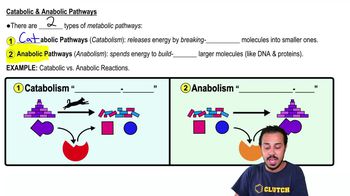
Anabolic reactions build new molecules and require energy, while catabolic reactions break down molecules and release energy.
Energy comes from the breakdown of ATP or other high-energy molecules during catabolic reactions.
Lipids produce more ATP than glucose because they have more carbon-hydrogen bonds to oxidize, yielding more energy.
Energy is stored in the high-energy phosphate bonds, especially the bond between the second and third phosphate groups.
Phosphorylation adds a phosphate to ADP to form ATP; dephosphorylation removes a phosphate from ATP to release energy and form ADP.
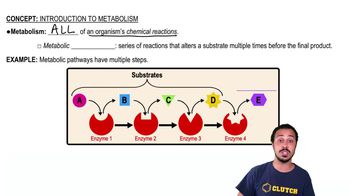
An enzyme is a biological catalyst that speeds up chemical reactions without being consumed.
Most enzyme names end with -ase.
A substrate is the specific molecule upon which an enzyme acts.
Activation energy is the energy required to start a chemical reaction.
An apoenzyme is the protein part of an enzyme alone; a holoenzyme is the apoenzyme plus its cofactor(s).
Cofactors are inorganic ions; coenzymes are organic molecules that assist enzyme function.
NAD+ and FAD are common coenzymes that carry electrons in catabolic pathways.
Enzymes are protein catalysts; ribozymes are RNA molecules with catalytic activity.
Denaturing is the loss of a protein's 3D structure, often caused by heat or pH changes, leading to loss of function.
Extreme pH can denature enzymes, disrupting their shape and function.
Kinases add phosphate groups; phosphatases remove phosphate groups from molecules.
Reduction is gain of electrons; oxidation is loss of electrons.
A redox reaction involves simultaneous oxidation and reduction, transferring electrons between molecules.
The reduced form of NAD+ is NADH.
The oxidized form of FADH2 is FAD.
Substrate-level phosphorylation transfers phosphate directly to ADP; oxidative phosphorylation uses electron transport chain and chemiosmosis; photophosphorylation uses light energy in photosynthesis.
Glycolysis is the first step; it does not require oxygen.
Glycolysis occurs in the cytoplasm of both prokaryotes and eukaryotes.
Glycolysis produces a net of 2 ATP per glucose molecule.
2 ATP are used in early steps, so net gain is 4 produced - 2 used = 2 ATP.
Glycolysis uses substrate-level phosphorylation to produce ATP.
Two pyruvic acid molecules are formed from one glucose molecule.
Two NADH molecules are produced per glucose during glycolysis.
The intermediate step occurs in the cytoplasm of prokaryotes and in the mitochondrial matrix of eukaryotes.
Two acetyl-CoA and two NADH molecules are produced from one glucose molecule.
2 CoA, 4 CO2, 6 NADH, 2 FADH2, 2 GTP (converted to ATP) are produced.
They are shuttled to the electron transport chain.
Substrate-level phosphorylation produces ATP in the Krebs cycle.
Krebs cycle occurs in the cytoplasm of prokaryotes and in the mitochondrial matrix of eukaryotes.
ETC is in the plasma membrane of prokaryotes and the inner mitochondrial membrane of eukaryotes.
Oxygen is the final electron acceptor in aerobic respiration.
Inorganic molecules like nitrate, sulfate, or carbonate serve as final electron acceptors.
The electron transport chain produces the most ATP.
The oxidase test detects cytochrome c oxidase.
Chemiosmosis is the movement of protons across a membrane to generate ATP via ATP synthase.
Electrons come from NADH and FADH2 produced in earlier steps.
Water (H2O) is formed after oxygen is reduced.
Entner-Doudoroff and pentose phosphate pathways are alternate carbohydrate metabolism routes.
Glycolysis produces pyruvic acid used in fermentation.
Fermentation produces about 2 ATP per glucose molecule.
Lactic acid is the main end product.
Lactic acid, ethanol, and CO2 are major end products.
Ethanol and CO2 are produced.
Lipase breaks down triglycerides into glycerol and fatty acids.
They break down proteins into smaller peptides and amino acids.
Fatty acids undergo beta oxidation, producing acetyl-CoA.
Deamination removes amino groups from amino acids for energy use or biosynthesis.
Gluconeogenesis is the synthesis of glucose from non-carbohydrate sources.
Glycogenesis is the formation of glycogen from glucose for storage.
Triglycerides are made of glycerol and three fatty acids.
Essential amino acids must be obtained from diet; nonessential amino acids can be synthesized by the body.
Autotrophs use CO2 as carbon source; heterotrophs use organic carbon sources.
Phototrophs use photophosphorylation; chemotrophs use oxidative phosphorylation or substrate-level phosphorylation.
To detect acid production from fermentation, which lowers pH and changes indicator color.
Catalase breaks down hydrogen peroxide into water and oxygen gas.