 Indietro
Microbiology: Prokaryotic and Eukaryotic Cell Structure and Function
 04:26
04:26
Termini in questo insieme (23)
1. All living organisms are composed of one or more cells.
2. The cell is the basic unit of structure and organization in organisms.
3. Cells arise from pre-existing cells.
Cells are made from nucleic acids, proteins, carbohydrates, and lipids.
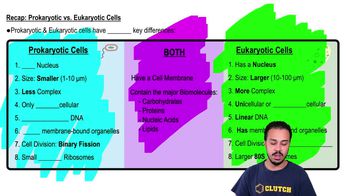
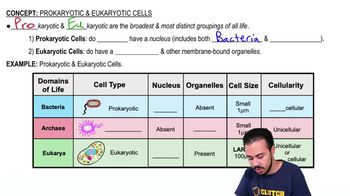
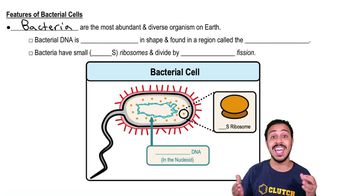
Bacteria and Archaea (prokaryotes) have circular chromosomes; Eukarya have linear chromosomes. Operons are present in Bacteria and Archaea but absent in Eukarya.
Coccus (round), Bacillus (rod), Vibrio (curved rod), Coccobacillus (short rod), Spirillum (spiral), Spirochete (long helical spiral).
Single cocci, diplococci (pairs), tetrads (groups of four), streptococci (chains), staphylococci (clusters), single bacillus, streptobacilli (chains of rods).
A viscous, gelatinous layer outside the cell wall made of polysaccharides and/or polypeptides; includes slime layers and capsules.
Protects bacteria from phagocytosis, enhances virulence, blocks immune recognition, and helps form biofilms.
Unorganized, easily removed polysaccharide/glycoprotein layer that protects cells from antibiotics and desiccation and aids adhesion to surfaces.
Protein or glycoprotein surface layer that self-assembles, providing protection against environmental stresses and host immune defenses.
Composed of filament (flagellin protein), hook, and basal body; enables bacterial motility by rotation.
Allows bacteria to move toward or away from stimuli (taxis) by rotating to run or tumble.
Archaeal motility structures made of archaellins; rotate like flagella but use ATP for energy.
Found in spirochetes; anchored at one end and cause corkscrew movement by rotation.
Hairlike appendages that allow attachment to surfaces and are involved in biofilm formation.
Appendages involved in DNA transfer (conjugation pili) and motility (gliding and twitching).
Made of peptidoglycan, a polymer of N-acetylglucosamine (NAG) and N-acetylmuramic acid (NAM) linked by polypeptides.
Thick peptidoglycan layer with teichoic acids and lipoteichoic acids; stains purple in Gram stain.
Thin peptidoglycan layer between inner membrane and outer membrane containing lipopolysaccharide (LPS); stains pink in Gram stain.
Crystal violet-iodine complexes retained in thick peptidoglycan of Gram-positive cells; washed out in Gram-negative cells due to outer membrane dissolution.
Similar to Gram-positive but with mycolic acid waxy coating; resists Gram stain and retains carbolfuchsin dye.
Prokaryotes lacking a cell wall; membrane stabilized by sterols; pleomorphic shapes.
May lack walls or have walls made of pseudomurein, which lacks NAM and D-amino acids.
Phospholipid bilayer with peripheral, integral, and transmembrane proteins; contains glycoproteins and glycolipids.