Skip to main content
Microbiology
Il mio corso
Impara
Preparazione agli esami
AI Tutor
Guide di studio
Soluzioni per libri di testo
Flashcard
Esplora
Prova l'app
Il mio corso
Impara
Preparazione agli esami
AI Tutor
Guide di studio
Soluzioni per libri di testo
Flashcard
Esplora
Prova l'app
Indietro
Microbiology Study Guide Basics
Puoi toccare per girare la carta.
Are viruses considered living organisms?
Puoi toccare per girare la carta.
👆
Are viruses considered living organisms?
Viruses are generally
not considered living organisms
because they cannot reproduce or carry out metabolism without a host cell.
Avanzamenti del tracciato
I pulsanti di controllo sono stati cambiati in modalità "navigazione".
1/14
Video consigliati
03:31
Steroids & Waxes
18394
views
208
rank
04:19
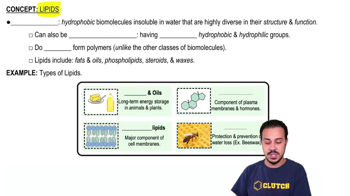
Lipids
24689
views
418
rank
06:59
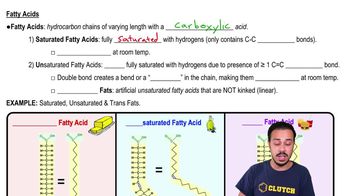
Fatty Acids
21879
views
327
rank
Termini in questo insieme (14)
Nascondere definizioni
Are viruses considered living organisms?
Viruses are generally
not considered living organisms
because they cannot reproduce or carry out metabolism without a host cell.
What are lipids?
Lipids
are fats and fat-like molecules important for energy storage and cell membrane structure.
What is the fatty acid tail in a lipid?
The
fatty acid tail
is the hydrophobic (water-repelling) part of a lipid molecule.
Define phospholipid.
A
phospholipid
is a lipid with a hydrophilic (water-attracting) head and hydrophobic tails, essential for membrane formation.
What is a bilayer in cell membranes?
A
bilayer
consists of two layers of phospholipids forming the basic structure of cell membranes.
What are triglycerides used for?
Triglycerides
serve as long-term energy storage molecules in organisms.
What role do phospholipids play in cells?
Phospholipids
form the structural basis of cell membranes, creating a barrier between inside and outside the cell.
What is the primary function of carbohydrates in the body?
Carbohydrates
are the body's major quick-energy nutrient.
What is a sugar in terms of carbohydrates?
A
sugar
is a simple carbohydrate used as an energy source.
Define monosaccharide.
A
monosaccharide
is a carbohydrate made of a single sugar unit.
What is a disaccharide?
A
disaccharide
is a carbohydrate composed of two sugar units linked together.
What is a polysaccharide?
A
polysaccharide
is a carbohydrate made of many sugar units linked in a chain.
What is glucose used for in cells?
Glucose
is a monosaccharide used by cells as a primary energy source.
What is glycogen?
Glycogen
is the stored form of glucose in animals, used for energy reserves.
 IndietroIndietro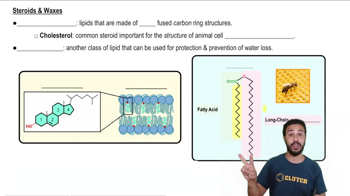
 03:31
03:31