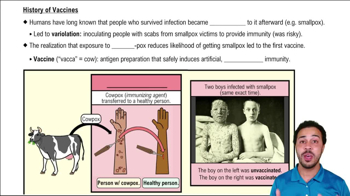
What was variolation and how was it used historically?
Variolation was an early method to combat smallpox by blowing powder made from dried smallpox scabs into a healthy person's nose, causing a milder infection with about 1–2% mortality.
What key observation did Edward Jenner make about milkmaids and smallpox?
Jenner observed milkmaids who had contracted cowpox were protected from smallpox, leading to the development of the first vaccine using cowpox material.
What is the origin of the word 'vaccination'?
The word 'vaccination' is derived from 'vacca,' the Latin word for cow, reflecting Jenner's use of cowpox to protect against smallpox.
Name two vaccines developed by Louis Pasteur.
Louis Pasteur developed early vaccines for rabies in humans and anthrax in cattle.
What is herd immunity and why is it important?
Herd immunity occurs when a high percentage of a population is vaccinated, making it difficult for a pathogen to spread and protecting those who cannot be immunized.
What vaccination coverage is generally needed for effective herd immunity?
Approximately 85% vaccination coverage is needed for most pathogens; measles and whooping cough require about 95% coverage.
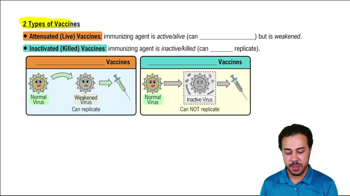
What are live attenuated vaccines?
Live attenuated vaccines contain weakened pathogens that are still infectious but do not cause disease, stimulating strong and long-lasting immunity.
List two drawbacks of live attenuated vaccines.
They can cause disease in immune-compromised hosts and may mutate back to a pathogenic form; they often require refrigeration.
What are inactivated vaccines and their benefits?
Inactivated vaccines contain whole pathogens that are killed by heat, chemicals, or radiation; they are safe for immune-compromised patients and stable at room temperature.
What are subunit vaccines and why do they require adjuvants?
Subunit vaccines contain purified antigens or parts of pathogens and require adjuvants to enhance the immune response.
Give examples of toxoid and conjugate vaccines.
Toxoid vaccines include tetanus and diphtheria components; conjugate vaccines include meningococcal, pneumococcal, and Haemophilus influenzae type b (Hib) vaccines.
How do mRNA vaccines work?
mRNA vaccines deliver purified mRNA encased in lipids to host cells, which translate it to produce antigenic proteins that trigger an immune response.
What is a recombinant vector vaccine?
A recombinant vector vaccine uses a harmless virus or bacterium to deliver genetic material from a pathogen to host cells, inducing immunity without causing disease.
Describe the principle of the plaque reduction neutralization test (PRNT).
PRNT measures patient antibodies by mixing virus with serum; antibodies coat the virus and reduce its ability to infect cells, seen as fewer plaques in culture.
What is the difference between indirect and sandwich ELISA?
Indirect ELISA detects antibodies binding to antigen-coated wells; sandwich ELISA captures antigen between two antibodies, increasing specificity.
How does immunofluorescence microscopy detect antigens?
It uses fluorescent-tagged antibodies that bind specific antigens, which are then visualized with a fluorescent microscope.
What is flow cytometry used for in microbiology?
Flow cytometry enumerates and sorts specific cells labeled with fluorescent antibodies, useful for immune cell analysis.
What are the key components required for PCR?
PCR requires template DNA, two primers, Taq polymerase, deoxynucleotide triphosphates (dNTPs), and a thermocycler.
Explain the three main steps of a PCR cycle.
Melting separates DNA strands at ~95°C, annealing allows primers to bind at 50–65°C, and extension copies DNA at 65–75°C.
What is the advantage of real-time PCR (qPCR)?
Real-time PCR uses fluorescence to visualize DNA amplification as it happens, allowing quantification of initial target DNA.
How does reverse transcription PCR (RT-PCR) differ from standard PCR?
RT-PCR converts RNA into complementary DNA using reverse transcriptase before amplification, enabling detection of RNA viruses like SARS-CoV-2.
What is CRISPR-Cas9 used for in molecular biology?
CRISPR-Cas9 is a gene-editing tool that cuts specific DNA sequences to allow insertion of corrected genes, useful for treating genetic diseases.
How is recombinant DNA technology used to produce vaccines?
Genes encoding antigens are amplified, inserted into plasmids, and expressed in bacteria to produce proteins used in vaccines.
What is gene therapy in the context of microbiology?
Gene therapy uses harmless viruses to deliver functional genes into human cells to treat genetic disorders.
 Indietro
 04:19