Skip to main content
Microbiology
Il mio corso
Impara
Preparazione agli esami
AI Tutor
Guide di studio
Soluzioni per libri di testo
Flashcard
Esplora
Prova l'app
Il mio corso
Impara
Preparazione agli esami
AI Tutor
Guide di studio
Soluzioni per libri di testo
Flashcard
Esplora
Prova l'app
Indietro
Microbiology: Vaccines, Immunological Testing, and Genetic Applications
Puoi toccare per girare la carta.
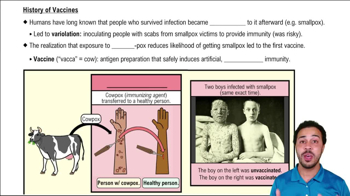
What was variolation and which pathogen was it targeting?
Puoi toccare per girare la carta.
👆
What was variolation and which pathogen was it targeting?
Variolation was an early Chinese procedure to induce immunity by exposing individuals to material from smallpox sores to protect against smallpox.
Avanzamenti del tracciato
I pulsanti di controllo sono stati cambiati in modalità "navigazione".
1/49
Video consigliati
04:19
History of Vaccines
440
views
10
rank
02:03
2 Types of Vaccines
380
views
5
rank
Termini in questo insieme (49)
Nascondere definizioni
What was variolation and which pathogen was it targeting?
Variolation was an early Chinese procedure to induce immunity by exposing individuals to material from smallpox sores to protect against smallpox.
Edward Jenner's contribution to science
Jenner developed the smallpox vaccine using cowpox virus, pioneering the concept of vaccination.
Louis Pasteur's role in vaccine development
Pasteur developed vaccines by attenuating pathogens, such as for rabies and anthrax, advancing vaccine science.
Next disease targeted for eradication after smallpox
Polio is targeted next, but eradication is difficult due to asymptomatic carriers and vaccine resistance.
Impact of the 1998 Lancet study on vaccination
The study falsely linked MMR vaccine to autism, harming vaccination efforts; it was later discredited and retracted.
Disease reemerging in US and UK due to declining vaccination
Measles is strongly reemerging due to reduced vaccination rates.
Type of immunity induced by vaccines
Vaccines induce artificially acquired active humoral immunity by stimulating adaptive immune responses.
What must a vaccine stimulate to be effective?
A vaccine must stimulate a strong adaptive immune response and produce immunological memory (Memory B and T cells).
Definition of herd immunity
Herd immunity occurs when enough of a population is immune to a disease, reducing its spread and protecting vulnerable individuals.
Two vulnerable populations protected by herd immunity
Infants too young to be vaccinated and immunocompromised individuals.
Meaning of 'shingles is a sequela to chickenpox'
Shingles occurs as a later consequence of a previous chickenpox infection due to reactivation of latent virus.
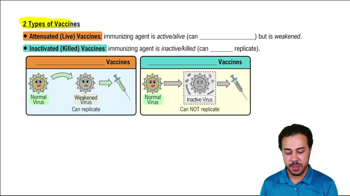
What are live attenuated vaccines?
Vaccines containing weakened but live pathogens that replicate to elicit strong immune responses.
Benefits and drawbacks of live attenuated vaccines
Benefits: strong, long-lasting immunity. Drawbacks: risk in immunocompromised, potential reversion, refrigeration needed.
What are inactivated vaccines?
Vaccines containing killed pathogens that cannot replicate but still stimulate immunity.
Advantages and disadvantage of inactivated vaccines
Advantages: safer for immunocompromised, stable. Disadvantage: weaker immune response, often need boosters.
Difference between whole-agent and subunit inactivated vaccines
Whole-agent uses entire killed pathogen; subunit uses only antigenic parts. Whole-agent may induce broader immunity.
What is an adjuvant?
A substance added to vaccines to enhance the immune response to the antigen.
What is a recombinant subunit vaccine?
A vaccine using genetically engineered antigens produced by recombinant DNA technology.
What is a toxoid vaccine? Examples?
Vaccines using inactivated bacterial toxins; examples include tetanus and diphtheria vaccines.
What are conjugate vaccines and why are they used?
Vaccines linking polysaccharides to proteins to improve immune response, especially in young children.
How do mRNA vaccines work?
mRNA vaccines deliver mRNA encoding a viral protein inside lipid nanoparticles, leading to protein production and immune activation.
What are recombinant vector vaccines?
Vaccines using harmless viruses or bacteria to deliver genes encoding antigens to stimulate immunity.
What are DNA vaccines and their main targets?
Vaccines delivering DNA encoding antigens; mainly developed for viral infections and cancers.
Define serology
The study and diagnostic use of serum antibodies to detect immune responses to pathogens.
What is agglutination in serology?
Clumping of particles when antibodies bind to antigens; requires specific antibodies and antigens.
Serological test used for blood typing and syphilis diagnosis
Agglutination tests are used for both blood typing and confirming syphilis.
What does a direct ELISA detect?
Direct ELISA detects antigens from a pathogen in patient serum, indicating current infection.
What does an indirect ELISA detect?
Indirect ELISA detects antibodies against an antigen, indicating past or ongoing exposure.
What does a sandwich ELISA detect?
Sandwich ELISA detects antigens in serum using two antibodies binding different epitopes.
What is immunofluorescence microscopy?
A technique using fluorescent-tagged antibodies to detect specific antigens in cells or tissues.
What is flow cytometry?
A method to analyze physical and chemical characteristics of cells using a laser-based instrument.
What are IGRAs and their use?
Interferon Gamma Release Assays detect immune response to tuberculosis infection in the USA.
What do western blots detect and how?
Western blots detect specific proteins by separating them via gel electrophoresis and probing with antibodies.
What is PCR and its purpose?
Polymerase Chain Reaction amplifies specific DNA sequences for detection or analysis.
Role of Taq polymerase in PCR
Taq polymerase is a heat-stable enzyme that synthesizes DNA during PCR cycles.
What is a thermocycler and PCR temperature steps?
A machine cycling temperatures for denaturation, annealing, and extension during PCR.
Purpose of gel electrophoresis
Separates DNA fragments by size for visualization after PCR or restriction digestion.
What is real-time PCR (qPCR)?
A PCR method that quantifies DNA amplification in real time using fluorescent markers.
What is RT-PCR and what does it detect?
Reverse Transcriptase PCR converts RNA to DNA to detect RNA viruses or gene expression.
Additional enzyme used in RT-PCR and its function
Reverse transcriptase synthesizes complementary DNA from RNA template.
Why was the Genetic Information Nondiscrimination Act (GINA) passed?
To prevent discrimination based on genetic information in health insurance and employment.
What is recombinant DNA (rDNA)?
DNA molecules formed by combining genetic material from different sources.
What are restriction enzymes?
Proteins that cut DNA at specific sequences, used in genetic engineering.
What is transformation in genetics?
The process of introducing foreign DNA into a cell.
What is CRISPR-Cas9?
A gene-editing tool using RNA-guided Cas9 nuclease to cut DNA at specific sites.
Function of CRISPR in CRISPR-Cas9
CRISPR provides the RNA guide sequence to target specific DNA regions.
Function of Cas9 in CRISPR-Cas9
Cas9 is the enzyme that cuts the DNA at the targeted site.
What is gene therapy?
Treatment involving insertion, alteration, or removal of genes to cure or prevent disease.
What do microarray assays investigate?
They analyze gene expression patterns or detect genetic variations across many genes.
 IndietroIndietro
 04:19