Skip to main content
Microbiology
Il mio corso
Impara
Preparazione agli esami
AI Tutor
Guide di studio
Soluzioni per libri di testo
Flashcard
Esplora
Prova l'app
Il mio corso
Impara
Preparazione agli esami
AI Tutor
Guide di studio
Soluzioni per libri di testo
Flashcard
Esplora
Prova l'app
Indietro
Microbiology: Vaccines, Immunology, and Diagnostic Tests
Puoi toccare per girare la carta.
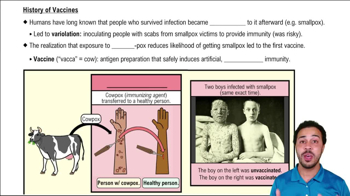
What was the purpose of variolation in early smallpox prevention?
Puoi toccare per girare la carta.
👆
What was the purpose of variolation in early smallpox prevention?
To expose individuals to a mild form of smallpox to induce immunity, though it could still cause severe disease and spread infection.
Avanzamenti del tracciato
I pulsanti di controllo sono stati cambiati in modalità "navigazione".
1/29
Video consigliati
04:19
History of Vaccines
440
views
10
rank
02:03
2 Types of Vaccines
380
views
5
rank
Termini in questo insieme (29)
Nascondere definizioni
What was the purpose of variolation in early smallpox prevention?
To expose individuals to a mild form of smallpox to induce immunity, though it could still cause severe disease and spread infection.
How did Edward Jenner's vaccine protect against smallpox?
By inoculating with cowpox material, a related but less dangerous virus, which provided immunity against smallpox.
What type of vaccine is MMR?
A live attenuated vaccine containing weakened measles, mumps, and rubella viruses that stimulate immune memory.
What are common routes of vaccine administration?
Oral (e.g., rotavirus), intramuscular (e.g., Tdap), and intranasal (e.g., nasal-spray influenza vaccine).
Why do vaccines not provide immediate protection?
The adaptive immune system requires time, usually about two weeks, to recognize antigens and develop protective antibodies.
Which groups are generally advised against receiving live attenuated vaccines?
Pregnant women and severely immunocompromised individuals due to risks of infection or fetal harm.
What is herd immunity?
When enough people in a community are immune, reducing disease transmission and indirectly protecting nonimmunized individuals.
List the common vaccine classifications.
Live attenuated, inactivated (whole-agent and subunit), toxoid, conjugate, DNA, and mRNA vaccines.
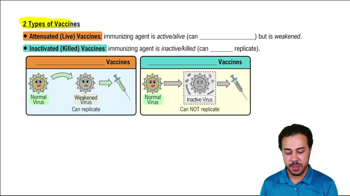
What is the benefit of live attenuated vaccines?
They produce strong antibody and cellular immune responses, often with longer-lasting protection.
What is a drawback of inactivated vaccines?
They often produce weaker or shorter-lived immunity, requiring multiple doses and boosters.
What distinguishes whole-agent vaccines from subunit vaccines?
Whole-agent vaccines contain entire inactivated pathogens; subunit vaccines contain selected antigen components.
What are toxoid vaccines?
Vaccines containing purified, inactivated bacterial toxins, such as tetanus toxoid.
What is a conjugate vaccine?
A vaccine linking a weak polysaccharide antigen to a carrier protein to enhance immune response.
What role do adjuvants play in vaccines?
They enhance the immune response to vaccine antigens, improving protection.
How do DNA and mRNA vaccines stimulate immunity?
By delivering genetic instructions for antigen production inside host cells, triggering adaptive immunity.
What is the main advantage of immunological diagnostic tests?
They provide faster, sensitive, and specific detection of antigens or antibodies without needing culture.
What is serology?
The study of antigen-antibody interactions, often used in immunological diagnostics.
How do agglutination tests work?
By clumping antigens and antibodies to detect the presence of specific molecules.
What is the principle of a sandwich ELISA?
The antigen is trapped between two antibodies, allowing sensitive detection.
What is the function of primers in PCR?
Primers bind to template DNA and provide a 3' end for DNA polymerase to extend the new strand.
What are the three main steps of PCR?
Denaturation (separating DNA strands), annealing (primers bind), and extension (DNA polymerase copies DNA).
How does real-time PCR differ from traditional PCR?
It provides quantitative data by visualizing DNA amplification as it occurs using fluorescence.
What is the Genetic Information Nondiscrimination Act (GINA) of 2008?
A law intended to protect individuals from discrimination based on genetic information, though with some loopholes.
What is CRISPR-Cas9?
A gene-editing tool derived from a prokaryotic immune system that can locate and cut specific DNA sequences.
How are viruses used in gene therapy?
Modified viruses act as vectors to deliver therapeutic genes into target cells either in vivo or ex vivo.
Why is annual influenza vaccination recommended?
Because immunity wanes over time and circulating influenza strains change yearly.
What vaccine is recommended during pregnancy to protect newborns from pertussis?
Tdap vaccine, preferably given between weeks 27 and 36 of pregnancy.
What is a key risk of live attenuated vaccines?
They may cause disease in immunocompromised individuals or revert to a virulent form.
What is the main benefit of inactivated vaccines for immunocompromised patients?
They are safe because they cannot replicate or cause infection.
 IndietroIndietro
 04:19