Indietro

Microscopy and Staining Techniques in Microbiology

I pulsanti di controllo sono stati cambiati in modalità "navigazione".
1/20
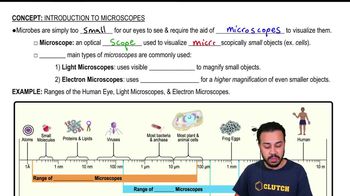
  • What is the primary purpose of a microscope in microbiology?

    To magnify and resolve small microorganisms that cannot be seen with the naked eye.
  • Name the main parts of a compound light microscope.

    • Ocular lens (eyepiece)
    • Objective lenses
    • Stage
    • Light source
    • Condenser
    • Diaphragm
    • Coarse and fine focus knobs
  • What does the ocular lens do?

    Magnifies the image formed by the objective lens, usually 10x magnification.
  • What is the function of the objective lenses?

    They provide the primary magnification of the specimen, typically ranging from 4x to 100x.
  • What role does the condenser play in microscopy?

    It focuses light onto the specimen to improve illumination and resolution.
  • What is the purpose of the diaphragm in a microscope?

    To control the amount of light reaching the specimen, affecting contrast and resolution.
  • Explain the difference between coarse and fine focus knobs.

    Coarse focus moves the stage quickly for rough focusing; fine focus adjusts the stage slowly for sharp detail.
  • What is resolution in microscopy?

    The ability to distinguish two close objects as separate entities.
  • How does staining help in microbiology?

    It increases contrast by coloring cells or cell parts, making them easier to see under a microscope.
  • What is a simple stain?

    A staining technique using one dye to color all cells the same, highlighting shape and arrangement.
  • What is a differential stain?

    A staining method that uses two or more dyes to distinguish different types of cells or cell parts.
  • Name a common differential stain used in microbiology.

    Gram stain, which differentiates bacteria into Gram-positive and Gram-negative groups.
  • What color do Gram-positive bacteria appear after Gram staining?

    Purple, due to retention of the crystal violet dye.
  • What color do Gram-negative bacteria appear after Gram staining?

    Pink or red, due to uptake of the counterstain safranin.
  • Why is heat fixing important before staining?

    It kills the bacteria, adheres them to the slide, and preserves their shape.
  • What is the purpose of the oil immersion lens?

    To increase resolution by reducing light refraction between the slide and lens using immersion oil.
  • How does magnification relate to resolution?

    Magnification enlarges the image, but resolution determines the clarity and detail visible.
  • What is the typical total magnification of a microscope using a 10x ocular and 40x objective lens?

    400x total magnification.
  • What is the role of the light source in a microscope?

    To provide illumination necessary to view the specimen clearly.
  • Why must slides be thin for microscopy?

    Thin slides allow light to pass through the specimen for clear viewing.