 Indietro
Prokaryotic Cell Structure and Function - Microbiology
 04:26
04:26
Termini in questo insieme (32)
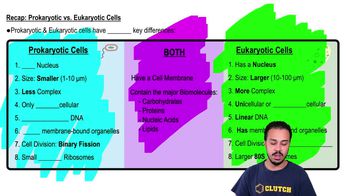
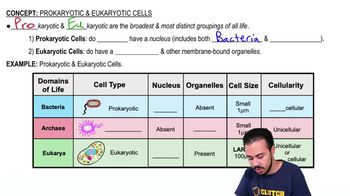
Prokaryotic cells lack a nucleus and membrane-bound organelles, have smaller size, and simpler structure compared to eukaryotic cells which have a nucleus and complex organelles.
Bacterial shapes include coccus (spherical), bacillus (rod), vibrio (comma-shaped), spirilli (spiral). Arrangements depend on division planes and include chains, clusters, pairs.
Monomorphic: single shape; Pleomorphic: variable shapes; Coccobacillary: short rods resembling cocci.
Vibrio (curved rods), spirilli (rigid helices), spirochetes (flexible helices). Differ in rigidity and motility mechanisms.
Division in one plane forms chains; two planes form tetrads; multiple planes form clusters or packets.
Cocci: singles, diplococci, chains, clusters; Bacilli: singles, pairs, palisades. MreB protein maintains rod shape in bacilli.
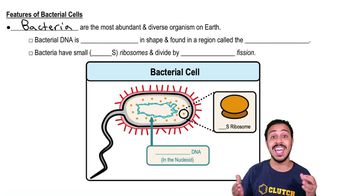
Cell membrane, cytoplasm, ribosomes, nucleoid (DNA), and cell wall.
Glycocalyx (capsules and slime layers), flagella, pili, fimbriae, axial filaments.
A gelatinous polysaccharide or polypeptide layer outside the cell wall that protects bacteria and aids in attachment.
Capsules are well-organized, firmly attached, and protect against phagocytosis; slime layers are loose, unorganized, and aid in attachment.
Flagellum enables motility; composed of filament, hook, and basal body which work together for rotation and movement.
Run: flagella rotate counterclockwise for smooth swimming; Tumble: clockwise rotation causes random reorientation.
Fimbriae aid in attachment to surfaces; pili facilitate DNA transfer during conjugation.
Located in spirochetes, wrapped around the cell between outer sheath and cell wall, enabling corkscrew motility.
Peptidoglycan, a polymer of sugars and amino acids forming a mesh-like layer.
Alternating N-acetylglucosamine (NAG) and N-acetylmuramic acid (NAM) sugars crosslinked by short peptides.
Thick peptidoglycan layer with teichoic acids (wall teichoic and lipoteichoic acids) that provide rigidity and charge.
Gram-positive: thick peptidoglycan, teichoic acids; Gram-negative: thin peptidoglycan, outer membrane with lipopolysaccharides.
Cell walls lacking typical peptidoglycan, e.g., Mycobacterium with mycolic acid, and Archaea with pseudopeptidoglycan.
Long-chain fatty acids in cell walls of Mycobacterium and Nocardia, providing waxy, hydrophobic properties.
Mycoplasma lack cell walls; their membranes contain sterols for stability.
Lysozyme, penicillin, detergents, and physical damage can disrupt peptidoglycan integrity.
Protoplasts: G+ cells without cell wall; Spheroplasts: G- cells with partial wall; L-forms: wall-deficient variants.
Phospholipid bilayer with proteins; functions include selective permeability, energy production, and transport.
Sterol-like molecules that stabilize bacterial membranes, similar to cholesterol in eukaryotes.
Outer leaflet: lipopolysaccharides (LPS); inner leaflet: phospholipids; functions include protection and selective permeability.
Lipid A (endotoxin), core polysaccharide, and O antigen; Lipid A causes toxic effects in hosts.
Proteins forming channels in the outer membrane allowing passage of small molecules.
G- have a large periplasmic space containing cell wall; G+ have a smaller periplasmic space.
Maintains rod shape by organizing cell wall synthesis in bacilli.
Both have 70S ribosomes composed of 50S and 30S subunits.
Highly resistant dormant structures formed by some bacteria to survive harsh conditions; formed by sporulation.