 Indietro
Study guide test 2
 05:45
05:45
Termini in questo insieme (21)
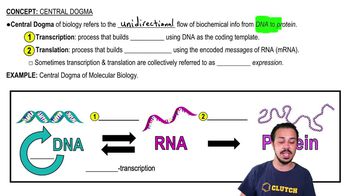
DNA is transcribed to mRNA, which is translated into protein that determines cellular function.
Genes are "off" with repressor bound to DNA; turned "on" when an inducer inactivates the repressor, allowing transcription.
Genes are "on" without repressor bound; turned "off" when a corepressor activates the repressor to bind DNA and block transcription.
Process where DNA strands separate and serve as templates for new complementary strands, involving enzymes like helicase, DNA polymerase, and ligase.
Two DNA strands run in opposite directions: one 5' to 3', the other 3' to 5', allowing complementary base pairing.
Short DNA fragments synthesized discontinuously on the lagging strand during DNA replication, later joined by DNA ligase.
RNA polymerase synthesizes a complementary mRNA strand from the DNA template, starting at the promoter and ending at the terminator.
mRNA codons are decoded by tRNA anticodons at the ribosome to assemble amino acids into a polypeptide chain.
Translation begins at the start codon AUG and ends at stop codons UAA, UAG, UGA.
Multiple ribosomes simultaneously translating a single mRNA molecule, increasing protein synthesis efficiency.
Introns are removed and exons spliced together by snRNPs to form mature mRNA before translation.
Includes promoter, operator, structural genes, and regulatory gene controlling gene expression in prokaryotes.
In absence of lactose, repressor binds operator to block transcription; lactose (inducer) inactivates repressor allowing gene expression.
Operon is on by default; excess tryptophan (corepressor) activates repressor to bind operator and stop transcription.
cAMP binds CAP protein, which attaches to promoter to enhance transcription when glucose is scarce.
Permanent change in DNA sequence that can alter protein function and phenotype.
Include silent (neutral), missense (amino acid change), nonsense (stop codon), and frameshift (insertion/deletion).
Agents like chemicals or radiation that increase mutation rates by damaging DNA or causing base substitutions.
Include photolyase for UV damage and nucleotide excision repair to remove and replace damaged DNA segments.
Transfer of genetic material between cells of the same generation via transformation, conjugation, or transduction.
Transfer of genetic information from parent to offspring during cell division.