Ch. 21 - Cardiovascular and Lymphatic Infections
Norman-McKay- Microbiology: Basic and Clinical Principles 2nd Edition
Norman-McKay2nd EditionMicrobiology: Basic and Clinical PrinciplesISBN: 9780137661619Non è quello che usi tu?Cambia libro di testo
Capitolo 17, Problema 6

A patient in the United States presents with symptoms of fever, chills, nausea, and a rash. Which of the following questions would provide a clue as to whether dengue fever, chikungungya, or Zika should be included in the differential diagnosis?
a. Have you recently traveled anywhere?
b. Has your sexual partner exhibited these symptoms recently?
c. Do you live near woods?
d. Have you been hiking lately?
e. Do you use intravenous drugs?

Guida verificata passo dopo passo
1
Step 1: Identify the common transmission routes and epidemiology of dengue fever, chikungunya, and Zika virus. All three are primarily transmitted by Aedes mosquitoes, which are prevalent in tropical and subtropical regions.
Step 2: Recognize that these diseases are often associated with travel to endemic areas where these mosquitoes are found, such as parts of Central and South America, the Caribbean, Africa, and Southeast Asia.
Step 3: Evaluate each question option to determine which one relates to exposure risk for mosquito-borne diseases. For example, asking about recent travel to endemic regions is crucial because it indicates potential exposure to infected mosquitoes.
Step 4: Understand that questions about sexual partner symptoms, living near woods, hiking, or intravenous drug use are less directly related to the typical transmission routes of these viruses. While Zika can be sexually transmitted, the primary clue for differential diagnosis in this context is travel history.
Step 5: Conclude that the question about recent travel is the most informative for including dengue, chikungunya, or Zika in the differential diagnosis because it directly addresses the likelihood of exposure to the mosquito vectors carrying these viruses.

Risposta video verificata per un problema simile:

Questa soluzione video è stata consigliata dai nostri tutor come utile per risolvere questo problema.
Durata del video:
2m

Concetti chiave

Ecco i concetti essenziali che devi comprendere per rispondere correttamente alla domanda.

Epidemiology and Transmission of Arboviral Diseases

Dengue fever, chikungunya, and Zika are arboviral infections transmitted primarily by Aedes mosquitoes. Understanding their geographic distribution and transmission routes, including travel to endemic areas, is crucial for diagnosis. Travel history helps identify exposure risk to these viruses, which are uncommon in the continental U.S. without travel.
Video consigliato:
04:57
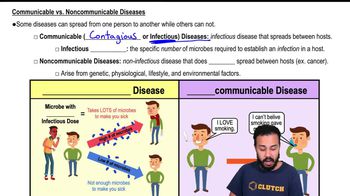
Communicable vs. Noncommunicable Diseases

Clinical Presentation of Arboviral Infections

Symptoms like fever, chills, nausea, and rash are common to dengue, chikungunya, and Zika, making clinical differentiation challenging. Recognizing overlapping symptoms and the need for epidemiological clues, such as recent travel, aids in narrowing the differential diagnosis and guiding further testing.
Video consigliato:
3:43
2) Viruses Interfere with Antigen Presentation in Infected Cells

Importance of Patient History in Differential Diagnosis

A thorough patient history, including recent travel, sexual contacts, and environmental exposures, is essential to identify potential infectious agents. For arboviral diseases, travel to endemic regions is a key factor, whereas other questions (e.g., sexual partner symptoms or intravenous drug use) are less relevant for these viruses.
Video consigliato:
04:34
Differential Media