Ch. 1 - The Microbial World and You
Tortora - Microbiology: An Introduction 14th Edition
Tortora14th EditionMicrobiology: An IntroductionISBN: 9780138200398Non è quello che usi tu?Cambia libro di testo
Capitolo 1, Problema 1.3a

Which of the following is the most important element of Koch’s germ theory of disease? The animal shows disease symptoms when
a. the animal has been in contact with a sick animal.
b. the animal has a lowered resistance.
c. a microorganism is observed in the animal.
d. a microorganism is inoculated into the animal.
e. microorganisms can be cultured from the animal.

Guida verificata passo dopo passo
1
Understand the context of Koch's germ theory of disease, which is a foundational concept in microbiology that establishes a link between a specific microorganism and a specific disease.
Recall that Koch's postulates are a series of criteria used to establish a causative relationship between a microbe and a disease.
Identify the key postulate relevant to the question: the microorganism must be isolated from a diseased organism and grown in pure culture.
Consider that the microorganism should cause disease when introduced into a healthy organism, which is a critical step in proving causation.
Evaluate the options given in the problem to determine which one aligns with the postulate that involves inoculating a microorganism into a healthy animal to observe if it causes disease symptoms.

Risposta video verificata per un problema simile:

Questa soluzione video è stata consigliata dai nostri tutor come utile per risolvere questo problema.
Durata del video:
2m

Concetti chiave

Ecco i concetti essenziali che devi comprendere per rispondere correttamente alla domanda.

Koch's Postulates

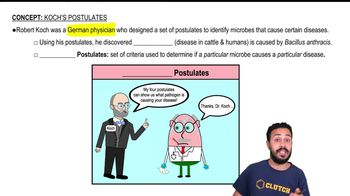
Koch's Postulates are a set of criteria established by Robert Koch to identify the causative agents of infectious diseases. They state that a specific microorganism must be found in all cases of the disease, isolated from the host, and capable of causing the disease when introduced to a healthy host. This framework is fundamental in microbiology for linking pathogens to diseases.
Video consigliato:
01:36
Koch's Postulates

Pathogenicity

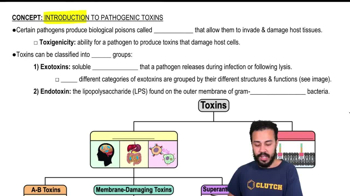
Pathogenicity refers to the ability of a microorganism to cause disease in a host. This concept encompasses various factors, including the microorganism's virulence, the host's immune response, and environmental conditions. Understanding pathogenicity is crucial for determining how and why certain microorganisms lead to disease symptoms.
Video consigliato:
03:40
Introduction to Pathogenic Toxins

Inoculation and Culturing

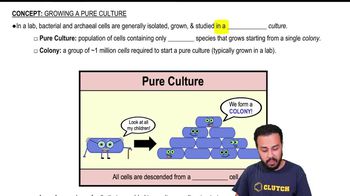
Inoculation is the process of introducing a microorganism into a host or culture medium to study its effects or to grow it in a controlled environment. Culturing involves growing microorganisms in specific conditions to observe their characteristics and behaviors. These techniques are essential for confirming the presence of pathogens and understanding their role in disease.
Video consigliato:
02:58
Growing a Pure Culture