
Ch. 11 - The Prokaryotes: Domains Bacteria and Archaea
Tortora - Microbiology: An Introduction 14th Edition
Tortora14th EditionMicrobiology: An IntroductionISBN: 9780138200398Non è quello che usi tu?Cambia libro di testo
Capitolo 7, Problema 10

Unlike purple and green phototrophic bacteria, cyanobacteria
a. Produce oxygen during photosynthesis.
b. Do not require light.
c. Use H₂S as an electron donor.
d. Have a membrane-enclosed nucleus.
e. All of the above

Guida verificata passo dopo passo
1
Step 1: Understand the key difference between cyanobacteria and purple/green phototrophic bacteria in terms of their photosynthetic process. Cyanobacteria are known for oxygenic photosynthesis, meaning they produce oxygen as a byproduct.
Step 2: Recall that purple and green phototrophic bacteria perform anoxygenic photosynthesis, which does not produce oxygen and often uses electron donors like hydrogen sulfide (H₂S) instead of water.
Step 3: Evaluate each option: (a) Cyanobacteria produce oxygen during photosynthesis, which is true; (b) Cyanobacteria require light for photosynthesis, so they do require light; (c) Cyanobacteria use water, not H₂S, as the electron donor; (d) Cyanobacteria are prokaryotes and do not have a membrane-enclosed nucleus.
Step 4: Based on the evaluation, identify which statement(s) correctly describe cyanobacteria compared to purple and green phototrophic bacteria.
Step 5: Conclude that the correct distinguishing feature is that cyanobacteria produce oxygen during photosynthesis, which corresponds to option (a).

Risposta video verificata per un problema simile:

Questa soluzione video è stata consigliata dai nostri tutor come utile per risolvere questo problema.
Durata del video:
2m

Concetti chiave

Ecco i concetti essenziali che devi comprendere per rispondere correttamente alla domanda.

Oxygenic vs. Anoxygenic Photosynthesis

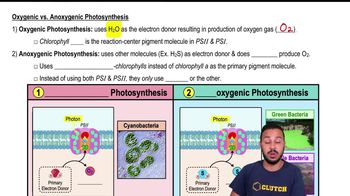
Cyanobacteria perform oxygenic photosynthesis, meaning they produce oxygen by splitting water molecules as an electron donor. In contrast, purple and green phototrophic bacteria conduct anoxygenic photosynthesis, using other compounds like hydrogen sulfide (H₂S) instead of water, and do not release oxygen.
Video consigliato:
05:23
Oxygenic vs. Anoxygenic Photosynthesis

Electron Donors in Photosynthesis

Electron donors provide the electrons needed for the photosynthetic electron transport chain. Cyanobacteria use water (H₂O) as the electron donor, releasing oxygen, whereas purple and green bacteria often use reduced sulfur compounds like H₂S, which do not produce oxygen.
Video consigliato:
05:23
Oxygenic vs. Anoxygenic Photosynthesis

Cellular Structure of Prokaryotes

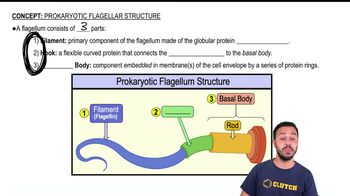
Cyanobacteria, like all bacteria, are prokaryotes and lack a membrane-enclosed nucleus. This distinguishes them from eukaryotic cells, which have a true nucleus. Purple and green bacteria are also prokaryotes, so none have a membrane-bound nucleus.
Video consigliato:
02:53
Prokaryotic Flagellar Structure