Ch. 17 - Adaptive Immunity: Specific Defenses of the Host
Tortora - Microbiology: An Introduction 14th Edition
Tortora14th EditionMicrobiology: An IntroductionISBN: 9780138200398Non è quello che usi tu?Cambia libro di testo
Capitolo 13, Problema 7

How would each of the following prevent infection?
a. Antibodies against Neisseria gonorrhoeae fimbriae
b. Antibodies against host cell mannose

Guida verificata passo dopo passo
1
Step 1: Understand the role of fimbriae in Neisseria gonorrhoeae infection. Fimbriae are hair-like appendages that help the bacteria attach to host cells, which is a critical first step in establishing infection.
Step 2: Explain how antibodies against Neisseria gonorrhoeae fimbriae would prevent infection. These antibodies would bind to the fimbriae, blocking the bacteria's ability to adhere to host cells, thereby preventing colonization and subsequent infection.
Step 3: Recognize that mannose residues on host cells serve as binding sites for certain bacterial adhesins, facilitating bacterial attachment and invasion.
Step 4: Describe how antibodies against host cell mannose would prevent infection. These antibodies would bind to the mannose residues on host cells, masking the binding sites and preventing bacteria that rely on mannose recognition from attaching effectively.
Step 5: Summarize that both types of antibodies interfere with the critical initial step of bacterial adhesion, which is essential for infection establishment, thus preventing the bacteria from colonizing and causing disease.

Risposta video verificata per un problema simile:

Questa soluzione video è stata consigliata dai nostri tutor come utile per risolvere questo problema.
Durata del video:
2m

Concetti chiave

Ecco i concetti essenziali che devi comprendere per rispondere correttamente alla domanda.

Role of Fimbriae in Bacterial Infection

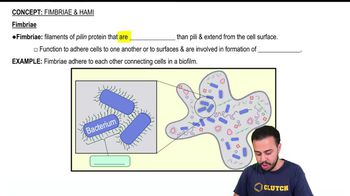
Fimbriae are hair-like appendages on bacteria like Neisseria gonorrhoeae that enable attachment to host cells, a critical first step in infection. By binding to specific receptors on host tissues, fimbriae facilitate colonization and invasion. Preventing this attachment can block infection initiation.
Video consigliato:
01:52
Fimbriae & Hami

Function of Antibodies in Immune Defense

Antibodies are proteins produced by the immune system that specifically recognize and bind to antigens, such as bacterial fimbriae or host molecules. This binding can neutralize pathogens, block their adhesion, or mark them for destruction by immune cells, thereby preventing infection.
Video consigliato:
00:48
Antibodies

Host Cell Mannose and Bacterial Adhesion

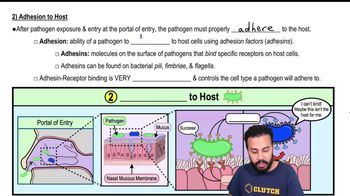
Mannose residues on host cell surfaces serve as binding sites for certain bacterial adhesins. Antibodies against host cell mannose could block these sites, preventing bacteria from attaching and invading. However, targeting host molecules risks autoimmunity or tissue damage.
Video consigliato:
03:59
2) Adhesion to Host
Pratica correlata
Domanda del libro di testo

Match the following choices to the statements in questions 5–7:

a. IgA

b. IgD

c. IgE

d. IgG

e. IgM

The first antibodies synthesized; especially effective against microorganisms.

910
views

Domanda del libro di testo

a. In the following graph, at time A the host was injected with tetanus toxoid. Show the response to a booster dose at time B.

b. Draw the antibody response of this same individual to exposure to a new antigen at time B.

1484
views
Domanda del libro di testo

A kidney-transplant patient experienced a cytotoxic rejection of the new kidney. Place the following in order for that rejection:

(1) apoptosis occurs

(2) CD8⁺ T cell becomes CTL

(3) granzymes released

(4) MHC class I activates CD8⁺ T cell

(5) perforin released

a. 1, 2, 3, 4, 5

b. 5, 4, 3, 2, 1

c. 4, 2, 5, 3, 1

d. 3, 4, 5, 1, 2

e. 2, 3, 4, 1, 5

1324
views
Domanda del libro di testo

Match the following choices to the statements in questions 5–7:

a. IgA

b. IgD

c. IgE

d. IgG

e. IgM

Antibodies that are bound to mast cells and involved in allergic reactions.

992
views
Domanda del libro di testo

Explain why a person who recovers from a disease can attend others with the disease without fear of contracting it.

1563
views
Domanda del libro di testo

Put the following in the correct sequence to elicit an antibody response:

(1) TH cell produces cytokines

(2) B cell contacts antigen

(3) antigen fragment goes to surface of the B cell

(4) TH recognizes antigen fragment and MHC

(5) B cell proliferates.

a. 1, 2, 3, 4, 5

b. 5, 4, 3, 2, 1

c. 3, 4, 5, 1, 2

d. 2, 3, 4, 1, 5

e. 4, 5, 3, 1, 2

1431
views