Ch. 23 - Microbial Diseases of the Cardiovascular and Lymphatic Systems
Tortora - Microbiology: An Introduction 14th Edition
Tortora14th EditionMicrobiology: An IntroductionISBN: 9780138200398Non è quello che usi tu?Cambia libro di testo
Capitolo 19, Problema 6

Which of the following is not a tickborne disease?
a. Babesiosis
b. Ehrlichiosis
c. Lyme disease
d. Relapsing fever
e. Tularemia

Guida verificata passo dopo passo
1
Step 1: Understand what tickborne diseases are. Tickborne diseases are illnesses transmitted to humans through the bite of infected ticks. Common examples include Lyme disease, babesiosis, ehrlichiosis, and relapsing fever.
Step 2: Review each option to determine if it is transmitted by ticks. Babesiosis, ehrlichiosis, Lyme disease, and relapsing fever are all known to be transmitted by ticks.
Step 3: Examine tularemia. Tularemia is caused by the bacterium Francisella tularensis and is primarily transmitted by ticks, deer flies, or contact with infected animals, but it is more commonly associated with other vectors and routes.
Step 4: Identify the disease that is least commonly or not typically transmitted by ticks compared to the others. This involves understanding the primary vectors and transmission routes for each disease.
Step 5: Conclude which disease is not considered a classic tickborne disease based on the typical transmission vectors and epidemiology.

Risposta video verificata per un problema simile:

Questa soluzione video è stata consigliata dai nostri tutor come utile per risolvere questo problema.
Durata del video:
1m

Concetti chiave

Ecco i concetti essenziali che devi comprendere per rispondere correttamente alla domanda.

Tickborne Diseases

Tickborne diseases are illnesses transmitted to humans through the bite of infected ticks. These diseases often involve bacteria, protozoa, or viruses that ticks carry and transmit during feeding. Understanding which diseases are commonly spread by ticks helps in identifying and preventing tick-related infections.
Video consigliato:
04:57
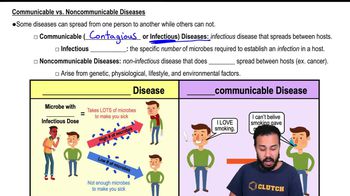
Communicable vs. Noncommunicable Diseases

Common Tickborne Diseases Listed

Babesiosis, ehrlichiosis, Lyme disease, and relapsing fever are well-known diseases transmitted by ticks. Each involves different pathogens: Babesiosis is caused by protozoa, ehrlichiosis and Lyme disease by bacteria, and relapsing fever by spirochetes. Recognizing these diseases helps differentiate them from non-tickborne illnesses.
Video consigliato:
04:57
Communicable vs. Noncommunicable Diseases

Tularemia Transmission

Tularemia is caused by the bacterium Francisella tularensis and can be transmitted by various vectors, including ticks, but also by other routes such as contact with infected animals or inhalation. However, it is less commonly classified strictly as a tickborne disease compared to the others listed, making it important to understand its transmission modes.
Video consigliato:
04:23
Transmission Electron Microscope (TEM)