Ch. 24 - Microbial Diseases of the Respiratory System
Tortora - Microbiology: An Introduction 14th Edition
Tortora14th EditionMicrobiology: An IntroductionISBN: 9780138200398Non è quello che usi tu?Cambia libro di testo
Capitolo 20, Problema 5

Match the following choices to the culture descriptions in questions 3 through 6:
a. Chlamydia
b. Coccidioides
c. Histoplasma
d. Mycobacterium
e. Mycoplasma
Microscopic examination of a lung biopsy shows ovoid cells in alveolar macrophages. You suspect these are the cause of the patient’s signs and symptoms, but your culture grows a filamentous organism.

Guida verificata passo dopo passo
1
Step 1: Identify the key observations from the problem: microscopic examination shows ovoid cells inside alveolar macrophages, and the culture grows a filamentous organism.
Step 2: Recall that ovoid cells inside alveolar macrophages are characteristic of Histoplasma capsulatum, a dimorphic fungus that appears as small yeast cells (ovoid) within macrophages in tissue.
Step 3: Understand that Histoplasma grows as a filamentous mold (mycelial form) in culture at environmental temperatures, which explains the filamentous organism observed in culture.
Step 4: Compare the other options: Chlamydia is an obligate intracellular bacterium, Coccidioides forms spherules in tissue, Mycobacterium is an acid-fast bacterium, and Mycoplasma lacks a cell wall and does not form filaments or ovoid cells in macrophages.
Step 5: Conclude that the description matches Histoplasma (option c) because of the ovoid yeast cells in macrophages and filamentous growth in culture.

Risposta video verificata per un problema simile:

Questa soluzione video è stata consigliata dai nostri tutor come utile per risolvere questo problema.
Durata del video:
2m

Concetti chiave

Ecco i concetti essenziali che devi comprendere per rispondere correttamente alla domanda.

Intracellular Pathogens and Their Morphology

Some pathogens, like Histoplasma, exist as ovoid yeast cells inside alveolar macrophages, indicating an intracellular lifestyle. Recognizing the typical microscopic appearance of these organisms helps differentiate them from others and guides diagnosis.
Video consigliato:
02:44
Types of Bacterial Cell Morphology

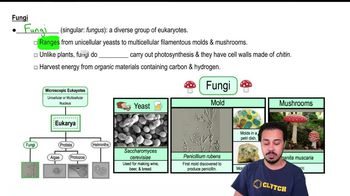
Dimorphic Fungi and Filamentous Growth

Dimorphic fungi, such as Histoplasma and Coccidioides, can grow as yeast in tissue and as filamentous molds in culture. This morphological switch is key for identification, as the filamentous form often appears in laboratory cultures despite yeast forms in the host.
Video consigliato:
02:49
Fungi

Correlation Between Microscopic Findings and Culture Results

Discrepancies between microscopic examination and culture morphology require understanding that some pathogens change form depending on environment. For example, seeing ovoid cells in tissue but filamentous growth in culture suggests a dimorphic fungus rather than bacteria or other microbes.
Video consigliato:
03:46
Light Microscopy: Bright-Field Microscopes