 Indietro
Chapter 14: Costs of Production
 05:51

Termini in questo insieme (29)
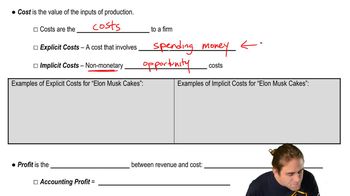
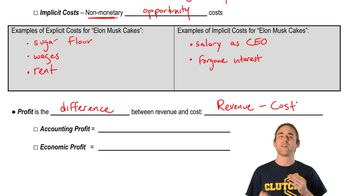
Costs paid with money, such as wages, rent, and materials. They have receipts or bills.
Opportunity costs of resources owned by the firm, like the owner's time or foregone interest. No money changes hands.
Total revenue minus explicit costs. Does not consider implicit costs.
Total revenue minus explicit and implicit costs. Reflects true profitability including opportunity costs.
Relationship between inputs (e.g., workers) and output (e.g., cupcakes). Shows how output changes as inputs change.
The extra output produced by adding one more unit of input (e.g., one more worker).
Each additional worker adds less output than the previous one, due to fixed resources.
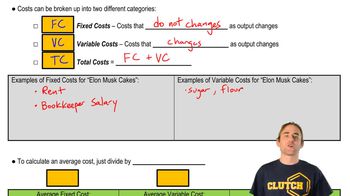
Costs that do not change with output, e.g., rent or oven cost. Paid even if output is zero.
Costs that change with output, such as wages and ingredients used per cupcake.
The sum of fixed costs and variable costs at each level of output.
The cost of producing one more unit of output. Calculated as change in total cost divided by change in quantity: \(\frac{\Delta TC}{\Delta Q}\).
Total cost divided by quantity produced: \(\frac{TC}{Q}\). It is the cost per unit on average.
Fixed cost divided by quantity: \(\frac{FC}{Q}\). Always falls as output increases.
Variable cost divided by quantity: \(\frac{VC}{Q}\). Usually rises as output increases due to diminishing marginal product.
ATC = AFC + AVC. The average total cost is the sum of average fixed and average variable costs.
Because of diminishing marginal product, each additional unit of input adds less output, raising the cost per extra unit.
U-shaped due to falling AFC and rising AVC as output increases.
Marginal cost crosses average total cost at its minimum point. Below this point, MC pulls ATC down; above, it pulls ATC up.
The quantity of output that minimizes average total cost, i.e., the bottom of the ATC curve.
Period in which at least one input (e.g., kitchen size) is fixed. Costs include fixed and variable.
Period long enough for all inputs to be variable. No fixed costs; firms can adjust all factors of production.
When long-run average total cost falls as output increases, often due to specialization.
When long-run average total cost stays the same as output increases.
When long-run average total cost rises as output increases, often due to management complexity.
Hire an additional worker only if the price per unit is at least as high as the marginal cost of producing the extra output.
Includes the value of the best alternative use of resources, such as the owner's foregone salary or interest income.
Because fixed costs are spread over more units as output increases, reducing cost per unit.
Due to diminishing marginal product, variable cost per unit increases as output grows.
Marginal product is the extra output from one more input; total output is the sum of all output produced.