Indietro

Chapter 15: Firms in Competitive Markets (Chapter 15)

I pulsanti di controllo sono stati cambiati in modalità "navigazione".
1/20
  • What defines a competitive market?

    • Many buyers and sellers
    • Identical goods
    • Free entry and exit
  • What is a price taker?

    A firm that accepts the market price and cannot influence it. For a price taker, P = AR = MR.
  • How is total revenue (TR) calculated?

    TR = price × quantity sold.
  • What is average revenue (AR)?

    AR = total revenue ÷ quantity sold; for a price taker, AR equals the market price.
  • What is marginal revenue (MR)?

    MR = change in total revenue ÷ change in quantity; for a price taker, MR equals the market price.
  • What is the profit maximization rule for a competitive firm?

    Produce the quantity where MR = MC to maximize profit.
  • When should a competitive firm shut down in the short run?

    If the market price is less than average variable cost (P < AVC), the firm should shut down.
  • When should a firm exit the market in the long run?

    If the market price is less than average total cost (P < ATC), the firm should exit.
  • What happens to profits in the long-run competitive equilibrium?

    Entry and exit drive the price to the minimum ATC, resulting in zero economic profit.
  • What is diminishing returns in production?

    Each additional worker adds fewer units of output, causing marginal cost to rise.
  • How does marginal cost (MC) relate to marginal product?

    When marginal product rises, MC falls; when marginal product falls, MC rises.
  • What is the efficient scale of production?

    The quantity that minimizes average total cost (ATC), where MC crosses ATC at its lowest point.
  • Why is the firm's supply curve the part of MC above AVC?

    Because the firm supplies output only when price covers variable costs, i.e., where MC > AVC.
  • What is a sunk cost?

    A cost that has already been incurred and cannot be recovered; it should be ignored in shutdown decisions.
  • How does a lump-sum tax affect cost curves?

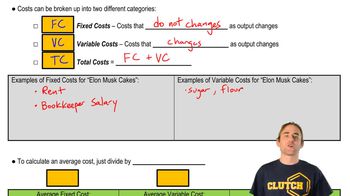
    It raises fixed costs, shifting AFC and ATC up but does not affect AVC or MC.
  • How does a per-unit tax affect cost curves?

    It raises variable costs, shifting AVC, ATC, and MC up but does not affect AFC.
  • What is the relationship between price, average revenue, and marginal revenue for a price taker?

    P = AR = MR; each additional unit sold adds exactly the market price to revenue.
  • Why might a firm continue operating at a loss in the short run?

    If price covers AVC but not total cost, the firm loses money but less than if it shut down.
  • What is the shutdown rule in the short run?

    Shut down if P < AVC; otherwise, keep producing to cover some fixed costs.
  • What is the exit rule in the long run?

    Exit the market if P < ATC because the firm cannot cover all costs.