 Indietro
Chapter 22: Consumer Choice Theory
 08:41

Termini in questo insieme (28)
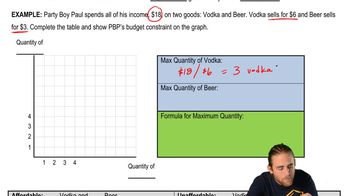
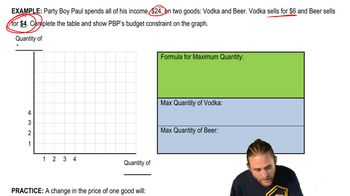
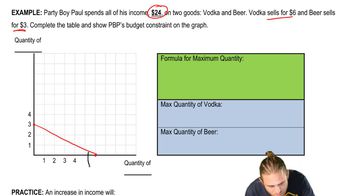
The limit on the consumption bundles a consumer can afford based on income and prices. It is represented as a straight line with ends at income ÷ price of each good.
The opportunity cost of one good in terms of the other, calculated as the price ratio: \(\frac{P_x}{P_y}\). It equals the rate at which the consumer must give up one good to get more of the other.
A curve showing all bundles of goods that give the consumer the same level of satisfaction or utility. It is downward sloping and bowed inward.
The rate at which a consumer is willing to give up one good to get one more unit of another good while staying equally happy. It is the slope of the indifference curve at a point.
The bundle where the highest indifference curve just touches the budget line. At this point, MRS = price ratio, and utility per dollar spent is equalized across goods.
An increase in income shifts the budget line outward parallel to the original line; a decrease shifts it inward. The slope remains unchanged.
A change in the price of one good causes the budget line to pivot around the intercept of the other good. The slope changes to reflect the new price ratio.
A good for which demand increases when income rises and decreases when income falls.
A good for which demand decreases when income rises and increases when income falls.
The change in quantity demanded of a good due to a change in its relative price, holding utility constant. It causes consumers to buy more of the cheaper good and less of the more expensive one.
The change in quantity demanded of a good resulting from a change in the consumer's purchasing power due to a price change. It moves the consumer to a higher or lower indifference curve.
An inferior good for which the income effect outweighs the substitution effect, causing demand to rise when its price rises, violating the law of demand.
Consumers maximize utility by allocating spending so that the marginal utility per dollar is equal across all goods: \(\frac{MU_x}{P_x} = \frac{MU_y}{P_y}\).
Goods with a constant MRS, meaning the consumer is always willing to substitute one good for the other at a fixed rate. Indifference curves are straight lines.
Goods consumed in fixed proportions, where extra units of one good do not increase utility without the other. Indifference curves are right angles.
The additional satisfaction or utility a consumer gets from consuming one more unit of a good.
The additional cost of consuming one more unit of a good, often equal to its price.
The difference between what a consumer is willing to pay for a good and what they actually pay, representing net benefit.
The demand curve is derived from the consumer's optimal choices at different prices, showing the quantity demanded at each price.
Measures how the quantity demanded of one good responds to a price change of another good. Negative for complements, positive for substitutes.
Measures how the quantity demanded of a good responds to a change in income. Positive for normal goods, negative for inferior goods, and greater than one for luxury goods.
Occurs when the consumer's MRS equals the price ratio, and the marginal utility per dollar spent is equalized across all goods.
Because the MRS decreases as the consumer has more of one good, reflecting diminishing willingness to substitute one good for another.
A price cut causes a pivot in the budget line and leads to two effects: the substitution effect (buy more of the cheaper good) and the income effect (feeling richer, buy more of normal goods).
The consumer's optimum occurs where the indifference curve is tangent to the budget line, meaning their slopes are equal: MRS = price ratio.
The amount of one good a consumer must give up to obtain one more unit of another good, reflected by the slope of the budget line.
When price falls, substitution effect leads to buying more, but income effect leads to buying less of the inferior good.
The downward slope of the demand curve arises because as price falls, consumers choose bundles with higher quantities of the good, combining substitution and income effects.