 Indietro
Chapter 6: Government Policies on Price Controls and Taxes
 07:07

Termini in questo insieme (28)
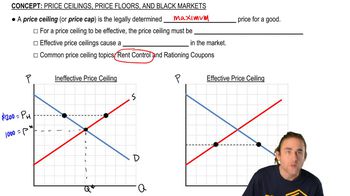
A legal maximum price set by the government. It is binding only if it is below the equilibrium price, causing a shortage where quantity demanded exceeds quantity supplied.
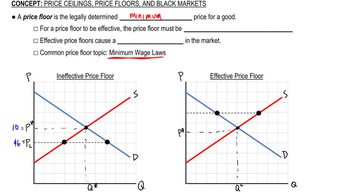
A legal minimum price set by the government. It is binding only if it is above the equilibrium price, causing a surplus where quantity supplied exceeds quantity demanded.
A price control that actually changes the market price by being on the 'wrong' side of equilibrium: ceiling below equilibrium or floor above equilibrium.
Occurs when the ceiling is below equilibrium price, causing quantity demanded (Qd) to exceed quantity supplied (Qs). Shortage = \(Q_d - Q_s\).
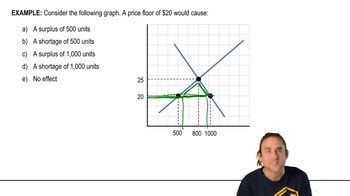
Occurs when the floor is above equilibrium price, causing quantity supplied (Qs) to exceed quantity demanded (Qd). Surplus = \(Q_s - Q_d\).
Landlords offer fewer apartments because the lower rent may not cover costs, leading some to leave the market or convert units, reducing supply.
A binding minimum wage above equilibrium reduces employment because firms demand fewer workers than supply, creating unemployment equal to surplus workers.
The price and quantity where quantity demanded equals quantity supplied, with no shortage or surplus.
The division of the tax burden between buyers and sellers, determined by the relative elasticities of demand and supply, not by who legally pays the tax.
Shifts the supply curve up (left) by the tax amount, raising the price buyers pay and lowering the price sellers keep, reducing quantity sold.
Shifts the demand curve down (left) by the tax amount, lowering the equilibrium quantity and price sellers receive, raising the price buyers pay including the tax.
The side of the market that is less elastic (fewer alternatives) bears more of the tax burden.
Demand is elastic if quantity demanded changes by a larger percentage than price changes (elasticity > 1), meaning consumers are responsive to price changes.
Demand is inelastic if quantity demanded changes by a smaller percentage than price changes (elasticity < 1), meaning consumers are less responsive to price changes.
When demand is elastic, a price increase (like a minimum wage) reduces total pay because quantity falls proportionally more than price rises.
1) Find equilibrium price and quantity. 2) Check if control is binding (ceiling below or floor above equilibrium). 3) Calculate shortage or surplus by subtracting quantities.
A tax always reduces the quantity sold because it increases the price buyers pay and decreases the price sellers receive.
Calculated as \(\text{Tax} \times \text{Quantity Sold}\) after the tax is imposed.
If the ceiling is at or above the equilibrium price, it does not affect the market price or quantity.
If the floor is at or below the equilibrium price, it does not affect the market price or quantity.
Price ceilings can cause shortages and black markets; price floors can cause surpluses and wasted resources.
A tax on sellers shifts the supply curve up by the tax amount because sellers receive less per unit sold after paying the tax.
A tax on buyers shifts the demand curve down by the tax amount because buyers effectively pay more per unit.
A binding minimum wage reduces employment because firms demand fewer workers at the higher wage, creating unemployment equal to surplus labor.
Shortage = \(Q_d - Q_s\) when price ceiling is binding.
Surplus = \(Q_s - Q_d\) when price floor is binding.
Buyers bear most of the tax because they cannot easily reduce quantity demanded.
Sellers bear most of the tax because buyers reduce quantity demanded significantly when price rises.