 Indietro
Microeconomics: Elasticity Concepts and Applications CH 4, 5
 04:56

Termini in questo insieme (28)
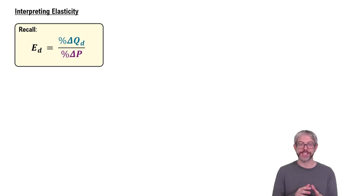
Price elasticity of demand measures the responsiveness of the quantity demanded of a good to a change in its price, holding other factors constant.
Price elasticity of demand = \(\frac{\%\text{ change in quantity demanded}}{\%\text{ change in price}}\).
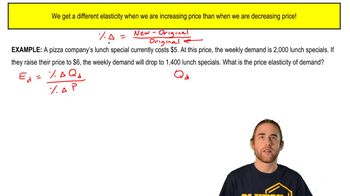
Using average price and quantity ensures the elasticity value is the same whether price rises or falls, making it a units-free measure.
An elasticity of 0 means perfectly inelastic demand, where quantity demanded does not change regardless of price changes.
An elasticity of 1 means unit elastic demand, where the percentage change in quantity demanded equals the percentage change in price.
Elasticity greater than 1 indicates elastic demand, where quantity demanded changes by a larger percentage than price.
Perfectly elastic demand means quantity demanded changes infinitely with a tiny price change; the demand curve is horizontal.
1. Closeness of substitutes
2. Proportion of income spent on the good
3. Time elapsed since the price change
The closer the substitutes for a good, the more elastic the demand, as consumers can easily switch to alternatives.
The larger the share of income spent on a good, the more elastic its demand tends to be.
Demand becomes more elastic over time as consumers have more opportunity to adjust their behavior or find substitutes.
Demand is elastic at prices above the midpoint, unit elastic at the midpoint, and inelastic below the midpoint.
If a price cut increases total revenue, demand is elastic; if total revenue decreases, demand is inelastic; if unchanged, demand is unit elastic.
Total revenue increases because the quantity demanded rises proportionally more than the price falls.
Total revenue decreases because the quantity demanded rises proportionally less than the price falls.
Income elasticity measures how quantity demanded changes in response to a change in consumer income.
The good is a normal good and demand is income elastic; quantity demanded changes more than income.
The good is a normal good but demand is income inelastic; quantity demanded changes less than income.
The good is an inferior good; quantity demanded decreases as income rises.
Cross elasticity measures how the quantity demanded of one good responds to a price change of another good (substitute or complement).
The goods are substitutes; an increase in the price of one increases demand for the other.
The goods are complements; an increase in the price of one decreases demand for the other.
Elasticity of supply measures the responsiveness of quantity supplied to a change in price, holding other factors constant.
Elasticity of supply = \(\frac{\%\text{ change in quantity supplied}}{\%\text{ change in price}}\).
1. Resource substitution possibilities
2. Time frame for supply decisions
Quantity supplied does not change with price; supply curve is vertical and elasticity is 0.
Quantity supplied changes infinitely with a tiny price change; supply curve is horizontal and elasticity is infinite.
Supply is more elastic in the long run as producers can adjust resources and production methods more easily.