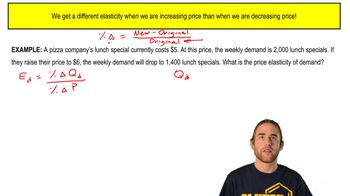
Why can't slope be used directly to calculate elasticity?
Slope depends on the unit of measurement, causing different values for the same data. Elasticity uses percentage changes to avoid this issue.
What formula is used to ensure a single elasticity value between two points?
The midpoint formula is used to calculate elasticity consistently between two points, avoiding different values when moving from A to B or B to A.
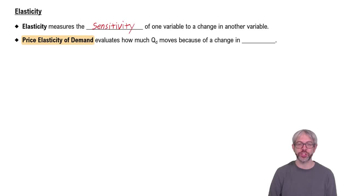
What is the Price Elasticity of Demand (PED)?
PED measures the responsiveness of quantity demanded to a change in price, calculated as the percentage change in quantity demanded divided by the percentage change in price.
How is PED interpreted when │E│ > 1?
Demand is price elastic, meaning quantity demanded is relatively responsive to price changes.
What does a PED value of -1.89 indicate?
A 1% increase in price causes a 1.89% decrease in quantity demanded, showing price elastic demand.
What is Cross-Price Elasticity of Demand (CPED)?
CPED measures the responsiveness of quantity demanded of one good to a change in the price of another good.
What does a negative CPED value indicate?
The goods are complements; an increase in the price of one decreases the quantity demanded of the other.
What does a positive CPED value indicate?
The goods are substitutes; an increase in the price of one increases the quantity demanded of the other.
What is Income Elasticity of Demand (IED)?
IED measures the responsiveness of quantity demanded to a change in income, calculated as the percentage change in quantity demanded divided by the percentage change in income.
How is a good classified if 0 < IED < 1?
The good is a necessity; demand increases with income but less than proportionally.
How is a good classified if IED > 1?
The good is a luxury; demand increases more than proportionally with income.
How is a good classified if IED < 0?
The good is inferior; demand decreases as income increases.
What is the Price Effect in relation to total revenue?
The change in revenue from a change in price, assuming quantity sold remains constant.
What is the Output Effect in relation to total revenue?
The change in revenue from a change in quantity sold, assuming price remains constant.
What happens to total revenue if demand is price elastic and price increases?
Total revenue decreases because the output effect (fewer units sold) outweighs the price effect.
What happens to total revenue if demand is price inelastic and price increases?
Total revenue increases because the price effect (higher price per unit) outweighs the output effect.
What is Price Elasticity of Supply (PES)?
PES measures the responsiveness of quantity supplied to a change in price, calculated as the percentage change in quantity supplied divided by the percentage change in price.
How does time affect Price Elasticity of Supply?
Supply is more price inelastic in the short run and more elastic in the long run as producers can adjust production.
What does a PES value of +0.69 indicate?
Supply is price inelastic; quantity supplied changes less than proportionally to price changes.
Why use the midpoint formula for elasticity calculations?
It provides a consistent elasticity value between two points, regardless of direction, avoiding discrepancies in calculations.
 Indietro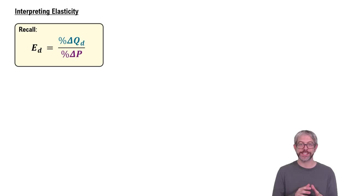
 04:56
04:56