 Indietro
Microeconomics Key Concepts and Principles
 01:42
01:42

Termini in questo insieme (29)
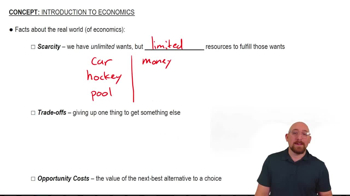
Economics is the study of how individuals and societies choose to use scarce resources provided by nature and previous generations.
Scarcity is a situation where resources are insufficient to satisfy all wants at a zero price.
Microeconomics studies the functioning of individual industries and the behavior of individual decision-making agents like firms and households.
Macroeconomics examines economic behavior of aggregates such as income, employment, output, and growth on a national scale.
Positive
Positive economics makes testable statements about what is or will be. Normative economics involves value judgments about what should be.
natural resources; Labor: human effort; Capital: produced goods used to produce other goods, including physical and human capital.
is the value of the best alternative forgone when making a choice.
What to produce? How to produce? Who gets the products?
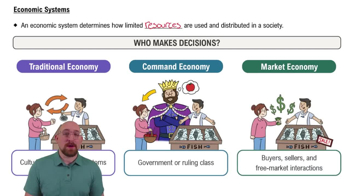
Command economy: central authority decides; Free market economy: markets decide; Mixed economy: combination of both.
is a simplified representation of reality used to explain or predict economic behavior by isolating key variables.
People are rational, decisions are made with available information, and ceteris paribus means all other things equal.
are costs that cannot be recovered and should not affect current decisions.
shows all efficient combinations of two goods that can be produced with fixed resources and technology.
MRT is the rate at which one good must be given up to produce an additional unit of another good; it equals the slope of the PPF.
As production of a good increases, resources less suited to its production are used, increasing the opportunity cost.
Points inside the PPF indicate inefficient resource use; points outside are unattainable with current resources.
Economic growth shifts the PPF outward due to increased resources or improved technology.
A country has an absolute advantage if it can produce a good using fewer resources than another country.
A country has a comparative advantage if it can produce a good at a lower opportunity cost than another country.
There is an inverse relationship between price and quantity demanded, ceteris paribus.
Change in quantity demanded is movement along the demand curve due to price change; change in demand is a shift of the curve caused by other factors.
Normal goods: demand increases as income rises; Inferior goods: demand decreases as income rises.
Complements: goods used together; price increase in one decreases demand for the other. Substitutes: goods used in place of each other; price increase in one increases demand for the other.
There is a direct relationship between price and quantity supplied, ceteris paribus.
Change in quantity supplied is movement along the supply curve due to price change; change in supply is a shift caused by other factors.
Changes in production costs, technology, number of firms, government policies, and weather can shift supply.
Equilibrium occurs where quantity demanded equals quantity supplied; no tendency for price to change.
Excess demand (shortage) occurs when price is below equilibrium; excess supply (surplus) occurs when price is above equilibrium.
Given Qd=120-2P and Qs=-30+3P, equilibrium price \(P^*=30\) and quantity \(Q^*=60\).