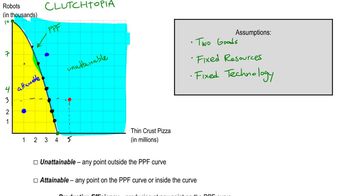
What does producing inside the Production Possibilities Frontier (PPF) indicate?
Producing inside the PPF means the firm is not using all its resources efficiently, possibly due to unemployment or inefficiency.
What does a point outside a firm's PPF represent?
A point outside the PPF represents an unattainable production level with current resources and technology; improvements are needed to reach it.
How does a firm decide which point on the PPF to produce at?
A firm chooses a point on the PPF based on preferences, costs, and market demand, balancing opportunity costs and benefits.
Why can two people both gain from trade even if one has an absolute advantage in both goods?
Because of comparative advantage, each should specialize in the good with the lower opportunity cost, allowing mutual gains from trade.
Difference between absolute advantage and comparative advantage?
Absolute advantage is producing more with the same resources; comparative advantage is producing at lower opportunity cost. Specialization should be based on comparative advantage.
Would a trade at 3 lbs of cherries per 1 lb of apples benefit if your opportunity cost is 1 lb cherries per apple and neighbor's is 2?
No, because the trade price is worse than your opportunity cost (3 > 1), so you wouldn't gain; beneficial trade prices lie between opportunity costs.
Difference between a change in demand and a change in quantity demanded?
A change in demand shifts the demand curve due to factors like income or preferences; a change in quantity demanded is movement along the curve due to price changes.
Effect on demand for water bottles if gym membership prices fall, given they are complements?
Demand for water bottles increases, raising their equilibrium price and quantity.
How do expectations of higher future prices affect demand and supply today?
Demand increases today as buyers try to purchase before prices rise; supply decreases as sellers hold back to sell later at higher prices.
What are consumer surplus and producer surplus?
Consumer surplus is the difference between what consumers are willing to pay and what they pay; producer surplus is the difference between price and production cost.
Why is economic surplus largest at competitive equilibrium?
Because at equilibrium, the quantity traded maximizes the sum of consumer and producer surplus, ensuring efficient resource allocation.
Do binding price ceilings or floors make all renters or workers better off?
No, binding controls create shortages or surpluses, benefiting some but harming others through reduced availability or unemployment.
Why does it not matter legally who pays a tax in terms of who bears the burden?
Tax incidence depends on relative elasticities of demand and supply, not on who is legally responsible for paying the tax.
What does perfectly inelastic demand mean?
Quantity demanded does not change regardless of price changes; demand curve is vertical.
Why is it wrong to draw inelastic demand as a vertical line if demand is inelastic but not perfectly so?
Because inelastic demand still responds slightly to price changes; a vertical line implies zero responsiveness.
If a price cut causes total revenue to fall, is demand elastic or inelastic?
Demand is inelastic because quantity demanded changes proportionally less than price, reducing total revenue.
Why might demand for soda be inelastic but demand for Coca-Cola be elastic?
Soda as a category has fewer substitutes (inelastic), while Coca-Cola faces many close substitutes, making its demand more elastic.
 Indietro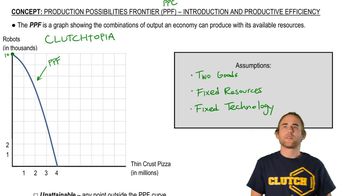
 06:23
06:23