 Indietro
Microeconomics Key Concepts: Surplus, Market Failure, and Elasticity
 06:03

Termini in questo insieme (27)
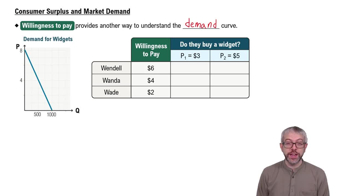
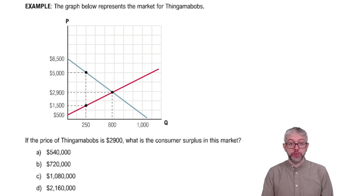
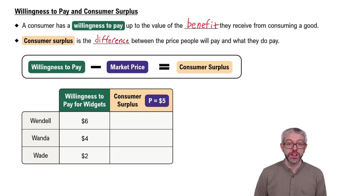
Consumer surplus is the difference between what consumers are willing to pay and what they actually pay.
Producer surplus is the difference between the price producers receive and their minimum acceptable price.
Consumer surplus is the area above the price and below the demand curve; producer surplus is the area below the price and above the supply curve.
Economic efficiency occurs when total surplus (consumer + producer surplus) is maximized, meaning resources are allocated optimally.
A price ceiling is a legal maximum price set below equilibrium, causing shortages; shown as a horizontal line below equilibrium price.
A price floor is a legal minimum price set above equilibrium, causing surpluses; shown as a horizontal line above equilibrium price.
Deadweight loss is the loss of total surplus due to market inefficiency, such as price controls or taxes.
Price ceilings or floors reduce trades below equilibrium quantity, shrinking total surplus and creating deadweight loss.
Tax revenue is the rectangle between the supply and demand curves at the taxed quantity, equal to tax per unit times quantity sold.
Market failure occurs when the market equilibrium is not efficient due to externalities affecting third parties.
An externality is a cost or benefit from a market activity imposed on a third party not involved in the transaction.
Negative externalities impose costs (e.g., pollution); positive externalities provide benefits (e.g., vaccinations).
Deadweight loss is the area between the social cost/benefit curve and the private cost/benefit curve over the inefficient quantity range.
Market equilibrium ignores external costs/benefits; efficient equilibrium accounts for social costs/benefits, leading to a different quantity.
Marginal private cost is the cost to producers; marginal social cost includes private cost plus external costs.
The Coase Theorem states that private parties can negotiate to solve externalities efficiently if property rights are clear and transaction costs are low.
Pigovian taxes are taxes imposed to correct negative externalities by aligning private costs with social costs.
Public goods (nonrival, nonexcludable), private goods (rival, excludable), common resources (rival, nonexcludable), quasi-public goods (nonrival, excludable).
The free-rider problem occurs when individuals consume a good without paying, common with public goods.
The tragedy of the commons is overuse of a common resource due to lack of exclusion, leading to depletion.
Price elasticity of demand measures how quantity demanded responds to price changes, calculated as % change in quantity / % change in price.
Elastic: elasticity > 1, quantity changes more than price; inelastic: elasticity < 1; unit elastic: elasticity = 1.
If demand is elastic, price and total revenue move opposite; if inelastic, they move together; if unit elastic, total revenue is maximized.
Determinants include availability of substitutes, necessity vs luxury, time horizon, and proportion of income spent.
Perfectly elastic demand is horizontal (infinite elasticity); perfectly inelastic demand is vertical (zero elasticity).
Cross-price elasticity measures how quantity demanded of one good changes with the price of another good.
Income elasticity measures how quantity demanded changes as consumer income changes.