Indietro

Microeconomics: Monopolistic Competition and Perfect Competition

I pulsanti di controllo sono stati cambiati in modalità "navigazione".
1/21
  • Characteristics of Monopolistic Competition

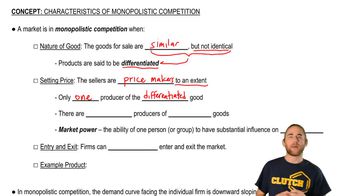
    • Many buyers and sellers
    • Selling similar but differentiated products/services
    • No significant barriers to entry
  • Difference between Perfect Competition and Monopolistic Competition

    Perfect competition sells identical products; monopolistic competition sells differentiated products, giving firms some pricing power.
  • Price Maker vs Price Taker

    Price makers can set prices above marginal cost (monopolistic competition); price takers accept market price (perfect competition).
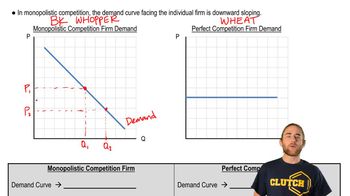
  • Demand Curve Shape for Monopolistic Competition

    Downward sloping demand curve; firms lose some but not all customers if price increases.
  • Market Power Definition

    Ability of a firm to charge a price greater than marginal cost (P > MC), indicating some control over price.
  • Economic Efficiency in Monopolistic Competition

    Lost due to P > MC; firms are not allocatively efficient, creating deadweight loss.
  • Relationship between Demand and Marginal Revenue in Monopolistic Competition

    MR curve lies below demand curve and has twice the slope; P ≠ MR.
  • Profit Maximization Rule for Firms

    Firms maximize profit by producing quantity where MR = MC.
  • Calculating Profit for a Firm

    Profit = (Price - Average Total Cost) × Quantity, or (P - ATC) × Q.
  • Effect of Entry of New Firms in Monopolistic Competition

    New firms entering shift incumbents' demand curves left and make them more elastic, reducing market power.
  • Long-Run Equilibrium in Monopolistic Competition

    Firms earn zero economic profit; price equals ATC but is greater than MC; excess capacity exists.
  • Excess Capacity in Monopolistic Competition

    Firms do not produce at minimum ATC, resulting in unused productive capacity.
  • Consumer Trade-Off in Monopolistic Competition

    Consumers pay higher prices and face inefficiency but gain product variety and differentiation.
  • Conditions for Firms to Maintain Long-Run Economic Profits

    Continuously differentiate products or reduce costs to sustain profits despite entry of competitors.
  • Characteristics of Perfectly Competitive Markets

    • Many buyers and sellers
    • Identical products
    • No barriers to entry or exit
  • Price Taker Definition

    A buyer or seller who cannot influence market price and must accept it.
  • Demand Curve for a Firm in Perfect Competition

    Perfectly elastic (horizontal) at market price; firm can sell any quantity at this price.
  • Relationship between Price, Marginal Revenue, and Average Revenue in Perfect Competition

    P = MR = AR; price equals marginal and average revenue.
  • Profit Maximization Condition

    Produce quantity where MR = MC to maximize profit.
  • Short-Run Shutdown Rule

    Shut down if price < average variable cost (P < AVC); otherwise, continue producing to minimize losses.
  • Long-Run Equilibrium in Perfect Competition

    Firms earn zero economic profit; P = ATC = MC; no incentive to enter or exit market.