 Indietro
Microeconomics: Technology, Production, and Costs
 05:51

Termini in questo insieme (29)
Technology is the process a firm uses to change inputs into outputs, including the actual technology, skills, training, and organization of production.
Technological advancements allow firms to produce more with the same inputs or the same output with fewer inputs, lowering total costs and shifting the supply curve to the right.
The short run is the period during which at least one input is fixed, so some costs are fixed and some are variable.
The long run is the period in which all inputs can be varied, so all costs are variable and there are no fixed costs.
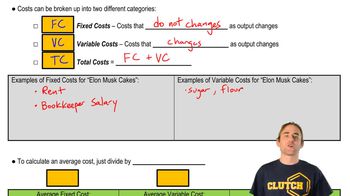
TC = FC + VC
Costs that change with output level; if output increases, VC increases; if output is zero, VC is zero.
Costs that remain constant regardless of output level, even if output is zero.
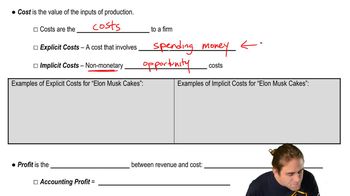
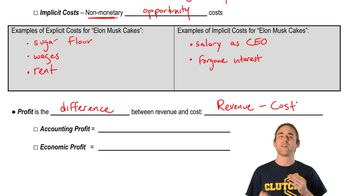
Explicit costs involve direct monetary payments; implicit costs are opportunity costs of using resources owned by the firm.
Economic cost = explicit costs + implicit costs, including opportunity costs and economic depreciation.
The relationship between inputs employed by a firm and the maximum output it can produce with those inputs.
The additional output produced by hiring one more worker; MPL = change in output / change in labor input.
Division of labor divides tasks among workers to reduce time wasted; specialization focuses workers on fewer tasks to increase efficiency.
Adding more of a variable input to fixed inputs eventually causes the marginal product of the variable input to decline.
Total output divided by the number of workers; APL = total output / labor input.
When MPL > APL, APL is rising; when MPL = APL, APL is at maximum; when MPL < APL, APL is falling.
The change in total cost from producing one more unit of output; MC = change in TC / change in quantity.
When MPL rises, MC falls; when MPL falls, MC rises, giving MC a U-shape.
ATC is U-shaped, initially decreasing due to efficiency gains, then increasing due to diminishing returns.
MC curve intersects ATC curve at its minimum point; when MC < ATC, ATC falls; when MC > ATC, ATC rises.
AFC decreases continuously as output increases because fixed costs are spread over more units.
LRAC shows the lowest cost at which a firm can produce any output level when all inputs are variable.
When increasing output causes long-run average costs to fall due to factors like specialization and quantity discounts.
The output level at which all economies of scale are exhausted and LRAC is minimized.
When increasing output does not change the long-run average cost.
When increasing output causes long-run average costs to rise, often due to management inefficiencies.
A curve showing all combinations of two inputs that produce the same output level.
The rate at which a firm can substitute one input for another while keeping output constant.
All combinations of two inputs that have the same total cost, similar to a budget constraint.
By choosing the input combination where the isoquant is tangent to the isocost line, equating MPL/price of labor to MPC/price of capital.