 Indietro
Monopolistic Competition and Market Structures in Microeconomics
 05:53

Termini in questo insieme (24)
A market with many firms selling identical products, where price equals marginal cost and firms earn zero economic profit in the long run.
A market with a single firm that has market power to set price above marginal cost, earning positive economic profit and causing deadweight loss.
Market structures between perfect competition and monopoly, where firms have some market power but face competition.
A market with few sellers offering similar or identical products, where strategic interactions among firms are crucial.
The percentage of total market output supplied by the four largest firms, used to measure market dominance.
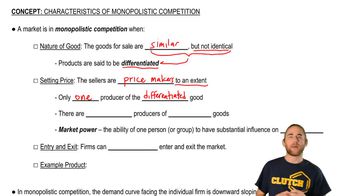
A market structure with many firms selling similar but differentiated products, free entry and exit, and zero economic profit in the long run.
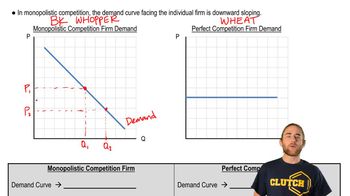
Many sellers, product differentiation, downward-sloping demand curve, and free entry and exit.
Produce quantity where marginal revenue equals marginal cost (MR = MC), then set price from the demand curve.
Firms can make profits if price > average total cost or losses if price < average total cost at the profit-maximizing quantity.
Entry and exit drive economic profit to zero, so price equals average total cost and demand curve is tangent to ATC.
Price exceeds marginal cost (P > MC) because of downward-sloping demand and MR < price.
Monopolistically competitive firms produce less than the efficient scale, operating on the downward-sloping part of the ATC curve.
The difference between price and marginal cost (P - MC) that exists in monopolistic competition but not in perfect competition.
Monopolistic competition has product differentiation, excess capacity, and price > marginal cost; perfect competition has identical products and P = MC.
Occurs due to price markup over marginal cost, causing some consumers to be deterred from buying despite valuing the good above MC.
Positive externality where new firms increase consumer surplus by offering more product choices.
Negative externality where new firms reduce profits of existing firms by taking customers away.
Firms advertise to attract buyers to differentiated products, spending a significant portion of revenue on advertising.
Advertising manipulates tastes, creates irrational brand loyalty, and reduces competition by making demand less elastic.
Advertising informs consumers about prices and products, fosters competition, and helps new firms enter the market.
Firms use costly advertising to signal product quality; only high-quality products can profitably afford expensive ads.
Provide consumers with quality information and give firms incentives to maintain product quality and reputation.
Brand names help consumers judge quality and encourage firms to maintain high standards to protect reputation.
Hybrid market structure with many firms, product differentiation, zero long-run profits, price > marginal cost, and advertising.