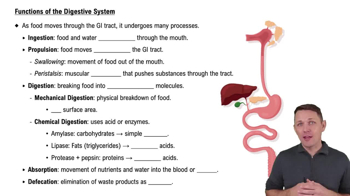
Digestion is the process of breaking down food into individual molecules small enough to be absorbed through the intestinal wall.
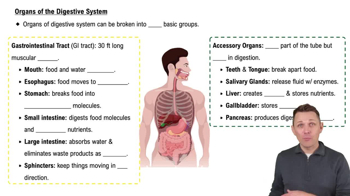
What organs make up the gastrointestinal (GI) tract?
The GI tract consists of the mouth, esophagus, stomach, small intestine, and large intestine.
What are the accessory organs in digestion?
Accessory organs include the liver, pancreas, and gallbladder, which aid digestion but are outside the GI tract.
What is mechanical digestion?
Mechanical digestion involves physically breaking down food by chewing, grinding, squeezing, and moving food through the GI tract by peristalsis and segmentation.
What is chemical digestion?
Chemical digestion breaks down food through enzymatic reactions that split nutrients into absorbable molecules.
What role does saliva play in digestion?
Saliva dissolves small food particles and contains amylase, an enzyme that begins carbohydrate digestion.
What is the function of the lower esophageal sphincter (LES)?
The LES relaxes to allow food into the stomach and contracts to prevent stomach contents from returning to the esophagus.
What is chyme?
Chyme is the semiliquid, partially digested food that leaves the stomach and enters the small intestine.
Name the three segments of the small intestine.
The small intestine consists of the duodenum, jejunum, and ileum.
How does the small intestine maximize nutrient absorption?
The small intestine has circular folds, villi, and microvilli that increase surface area by over 600 times.
What are the main functions of the large intestine?
The large intestine absorbs water, sodium, potassium, and chloride, and houses bacteria that produce some vitamins.
What are the two primary muscular contractions that move food through the GI tract?
Peristalsis squeezes food forward, and segmentation shifts food back and forth to increase contact with intestinal walls.
What is the role of digestive enzymes?
Digestive enzymes catalyze hydrolysis, breaking chemical bonds in nutrients using water.
What conditions are required for enzymes to function properly?
Enzymes require the correct substrate, optimal pH, and optimal temperature to work efficiently.
Name three digestive enzymes and their substrates.
 Indietro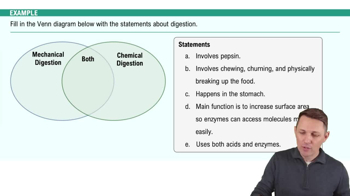
 02:19
02:19