Ch. 10 - Reactions of Alcohols, Ethers, Epoxides, Amines, and Sulfur-Containing Compounds
Bruice - Organic Chemistry 8th Edition
Bruice8th EditionOrganic ChemistryISBN: 9780135213711Non è quello che usi tu?Cambia libro di testo
Capitolo 10, Problema 58c

Starting with (R)-1-deuterio-1-propanol, how could you prepare
c. (R)-1-deuterio-1-methoxypropane?

Guida verificata passo dopo passo
1
Identify the functional group transformation: The problem involves converting (R)-1-deuterio-1-propanol (an alcohol) into (R)-1-deuterio-1-methoxypropane (an ether). This is a Williamson ether synthesis, which typically involves the reaction of an alcohol with a strong base followed by an alkyl halide.
Deprotonate the alcohol: Treat (R)-1-deuterio-1-propanol with a strong base such as sodium hydride (NaH) or sodium metal (Na). This will generate the corresponding alkoxide ion, \( \text{CH}_3\text{CHD}\text{O}^- \), which is a strong nucleophile.
Select the appropriate alkyl halide: To form the ether, choose methyl iodide (\( \text{CH}_3\text{I} \)) as the alkyl halide. This is a good electrophile for the nucleophilic substitution reaction due to the leaving group (iodide) being highly reactive.
Perform the nucleophilic substitution: React the alkoxide ion with methyl iodide in an SN2 reaction. The nucleophilic oxygen of the alkoxide attacks the carbon of the methyl group, displacing the iodide ion and forming (R)-1-deuterio-1-methoxypropane.
Ensure stereochemistry is retained: Since the reaction occurs at the oxygen atom and does not involve the chiral center directly, the stereochemistry at the chiral center (R configuration) is retained throughout the process.

Risposta video verificata per un problema simile:

Questa soluzione video è stata consigliata dai nostri tutor come utile per risolvere questo problema.
Durata del video:
9m

Concetti chiave

Ecco i concetti essenziali che devi comprendere per rispondere correttamente alla domanda.

Stereochemistry

Stereochemistry is the study of the spatial arrangement of atoms in molecules and how this affects their chemical properties and reactions. In this context, understanding the stereochemistry of (R)-1-deuterio-1-propanol is crucial, as the configuration must be preserved during the transformation to (R)-1-deuterio-1-methoxypropane.
Video consigliato:
Percorso guidato
1:38
Polymer Stereochemistry Concept 1

Nucleophilic Substitution Reactions

Nucleophilic substitution reactions involve the replacement of a leaving group in a molecule by a nucleophile. In the preparation of (R)-1-deuterio-1-methoxypropane, a nucleophile (methoxide ion) will attack the carbon atom bonded to the leaving group (hydroxyl group) in (R)-1-deuterio-1-propanol, leading to the desired product.
Video consigliato:
01:47
Nucleophiles and Electrophiles can react in Substitution Reactions.

Deuterium Labeling

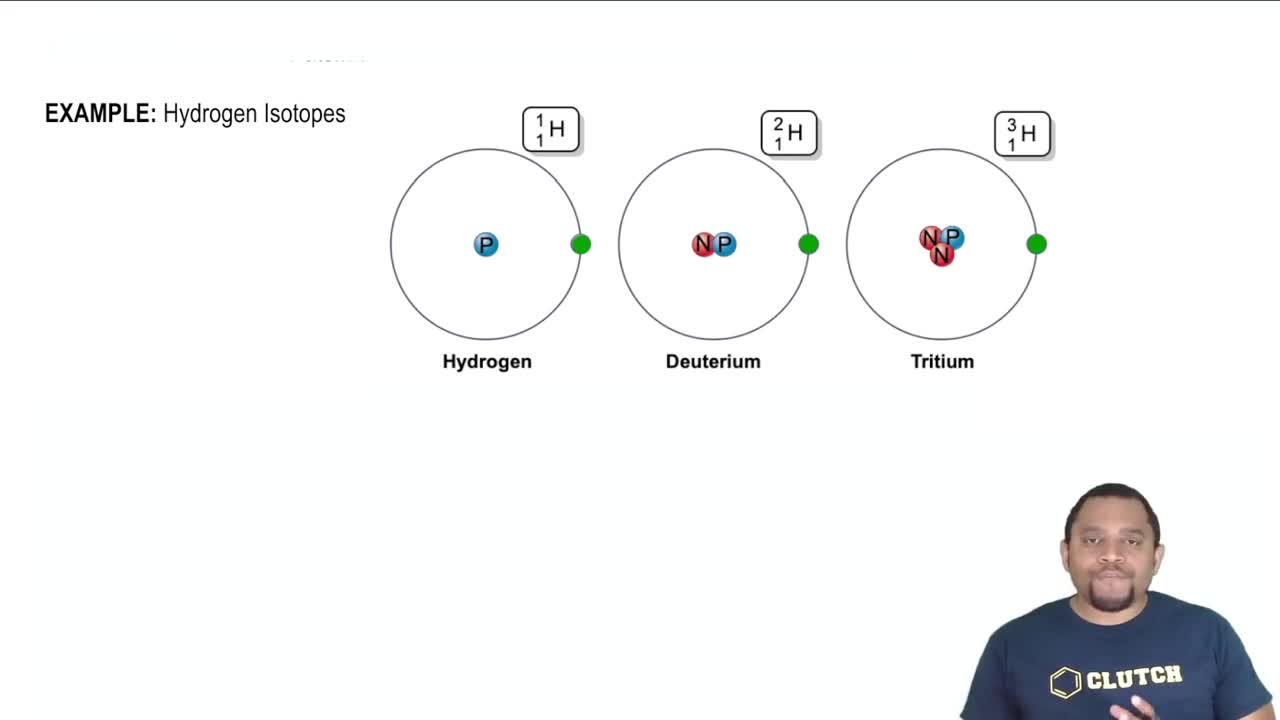
Deuterium labeling refers to the incorporation of deuterium, a stable isotope of hydrogen, into organic molecules. This is important in this question as the starting material is (R)-1-deuterio-1-propanol, and maintaining the deuterium label during the reaction is essential for tracking the isotopic composition of the final product, (R)-1-deuterio-1-methoxypropane.
Video consigliato:
03:06
Understanding the hydrogen isotopes.