Ch. 10 - Reactions of Alcohols, Ethers, Epoxides, Amines, and Sulfur-Containing Compounds
Bruice - Organic Chemistry 8th Edition
Bruice8th EditionOrganic ChemistryISBN: 9780135213711Non è quello che usi tu?Cambia libro di testo
Capitolo 10, Problema 14(b)

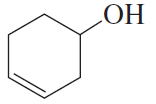
What is the major product obtained when each of the following alcohols is heated in the presence of H2SO4?
b. Chemical structure of cyclohexanol, showing a hydroxyl group (OH) attached to a six-membered carbon ring.

Guida verificata passo dopo passo
1
Step 1: Recognize the reaction type. Heating an alcohol in the presence of H2SO4 typically leads to an elimination reaction (E1 mechanism), resulting in the formation of an alkene. This occurs via dehydration, where water is removed from the alcohol.
Step 2: Identify the structure of the alcohol. The given alcohol is a secondary alcohol attached to a cyclopentane ring with a double bond present in the ring. Secondary alcohols undergo elimination reactions readily under acidic conditions.
Step 3: Protonation of the alcohol group. In the presence of H2SO4, the hydroxyl group (-OH) is protonated to form a better leaving group, water (H2O). This step increases the reactivity of the molecule.
Step 4: Formation of the carbocation intermediate. After the water molecule leaves, a carbocation is formed at the carbon where the hydroxyl group was attached. The stability of the carbocation is crucial in determining the major product. In this case, the carbocation is stabilized by the cyclopentane ring.
Step 5: Rearrangement and elimination. The carbocation undergoes elimination of a proton from a β-carbon (adjacent to the carbocation), leading to the formation of the most stable alkene. The major product will be determined by Zaitsev's rule, which states that the more substituted alkene is favored.

Risposta video verificata per un problema simile:

Questa soluzione video è stata consigliata dai nostri tutor come utile per risolvere questo problema.
Durata del video:
2m

Concetti chiave

Ecco i concetti essenziali che devi comprendere per rispondere correttamente alla domanda.

Dehydration of Alcohols

Dehydration of alcohols is a common reaction in organic chemistry where an alcohol loses a water molecule, typically in the presence of an acid catalyst like sulfuric acid (H2SO4). This process often leads to the formation of alkenes or ethers, depending on the structure of the alcohol and the reaction conditions. Understanding this reaction is crucial for predicting the products formed when heating alcohols.
Video consigliato:
01:23
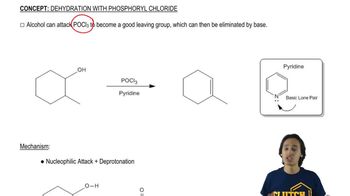
General Reaction of Dehydration with POCl3

Mechanism of Acid-Catalyzed Dehydration

The mechanism of acid-catalyzed dehydration involves protonation of the alcohol's hydroxyl group, making it a better leaving group. This is followed by the formation of a carbocation intermediate, which can rearrange to a more stable form if possible. Finally, a water molecule is eliminated, resulting in the formation of an alkene. Recognizing this mechanism helps in determining the major product based on the stability of the carbocation formed.
Video consigliato:
06:01
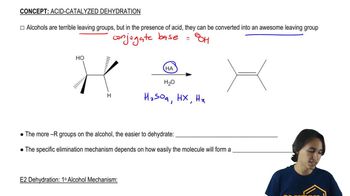
General features of acid-catalyzed dehydration.

Carbocation Stability

Carbocation stability is a key concept in organic chemistry that influences the outcome of reactions involving carbocations. Tertiary carbocations are more stable than secondary, which are more stable than primary due to hyperconjugation and inductive effects. In the context of dehydration reactions, the stability of the carbocation intermediate will dictate the major product formed, as more stable carbocations are favored in the reaction pathway.
Video consigliato:
05:58
Determining Carbocation Stability