Ch. 10 - Reactions of Alcohols, Ethers, Epoxides, Amines, and Sulfur-Containing Compounds
Bruice - Organic Chemistry 8th Edition
Bruice8th EditionOrganic ChemistryISBN: 9780135213711Non è quello che usi tu?Cambia libro di testo
Capitolo 10, Problema 63c

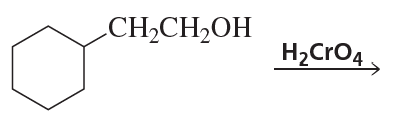
What is the major product(s) of each of the following reactions?
c. Chemical structure showing ethanol reacting with chromic acid, indicating an oxidation reaction.

Guida verificata passo dopo passo
1
Step 1: Identify the functional group in the starting material. The molecule contains a primary alcohol (-OH group) attached to a cyclopentyl group.
Step 2: Recognize the reagent used in the reaction. H₂CrO₄ (chromic acid) is a strong oxidizing agent commonly used to oxidize alcohols.
Step 3: Understand the oxidation process for primary alcohols. Primary alcohols are oxidized by chromic acid to form carboxylic acids. The intermediate aldehyde is typically not isolated because chromic acid continues to oxidize it to the carboxylic acid.
Step 4: Predict the major product. The primary alcohol will be oxidized to a carboxylic acid, resulting in a cyclopentyl carboxylic acid (cyclopentanecarboxylic acid).
Step 5: Verify the reaction conditions. Ensure that the reaction proceeds under acidic conditions, which are typical for chromic acid oxidation, and confirm that no other functional groups in the molecule interfere with the oxidation process.

Risposta video verificata per un problema simile:

Questa soluzione video è stata consigliata dai nostri tutor come utile per risolvere questo problema.
Durata del video:
46s

Concetti chiave

Ecco i concetti essenziali che devi comprendere per rispondere correttamente alla domanda.

Oxidation of Alcohols

The oxidation of alcohols involves the conversion of the hydroxyl (-OH) group into a carbonyl group (C=O) or a carboxylic acid, depending on the type of alcohol and the oxidizing agent used. Primary alcohols typically oxidize to aldehydes and can further oxidize to carboxylic acids, while secondary alcohols oxidize to ketones. Tertiary alcohols do not undergo oxidation under these conditions.
Video consigliato:
05:53
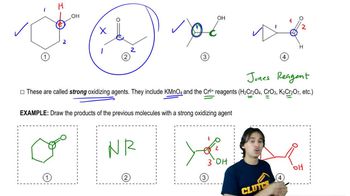
Strong oxidizing agents

Chromic Acid (H2CrO4) as an Oxidizing Agent

Chromic acid (H2CrO4) is a strong oxidizing agent commonly used in organic chemistry to oxidize alcohols. It is particularly effective for converting primary and secondary alcohols into their corresponding carbonyl compounds. The reaction typically involves the transfer of oxygen and the reduction of chromium from a +6 to a +3 oxidation state, resulting in a color change that indicates the progress of the reaction.
Video consigliato:
05:53
Strong oxidizing agents

Reaction Mechanism

Understanding the reaction mechanism is crucial for predicting the products of organic reactions. In the case of alcohol oxidation, the mechanism involves the formation of a chromate ester intermediate, followed by the elimination of water to form the carbonyl compound. This stepwise process highlights the importance of electron movement and the role of the oxidizing agent in facilitating the transformation of functional groups.
Video consigliato:
02:16
Heck Reaction Mechanism