Ch. 10 - Reactions of Alcohols, Ethers, Epoxides, Amines, and Sulfur-Containing Compounds
Bruice - Organic Chemistry 8th Edition
Bruice8th EditionOrganic ChemistryISBN: 9780135213711Non è quello che usi tu?Cambia libro di testo
Capitolo 10, Problema 33a,b

What stereoisomers are obtained from the reaction of the alkenes in [PROBLEM 10-32] with a peroxyacid ­followed by reaction with hydroxide ion?
a. trans-2-butene
b. cis-2-butene

Guida verificata passo dopo passo
1
Identify the reaction type: The reaction involves the conversion of an alkene into an epoxide using a peroxyacid (e.g., mCPBA) followed by a ring-opening reaction with hydroxide ion. This is a two-step reaction mechanism.
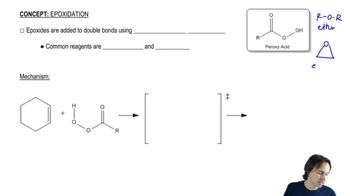
Step 1: Epoxidation of the alkene. The peroxyacid reacts with the alkene to form an epoxide. The stereochemistry of the epoxide depends on the stereochemistry of the starting alkene. If the alkene is cis, the epoxide will also be cis (retention of stereochemistry). If the alkene is trans, the epoxide will be trans.
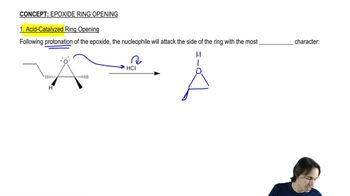
Step 2: Ring-opening of the epoxide. The hydroxide ion attacks the less sterically hindered carbon of the epoxide in an SN2 mechanism. This results in inversion of configuration at the carbon being attacked, leading to the formation of a diol.
Analyze the stereochemistry of the products: Depending on the stereochemistry of the starting alkene (cis or trans), the diol products will have different stereochemical relationships (e.g., enantiomers or diastereomers). For example, a cis-alkene will yield a meso diol, while a trans-alkene will yield a pair of enantiomers.
Summarize the stereoisomers: Based on the stereochemistry of the starting alkene, determine whether the products are enantiomers, diastereomers, or a meso compound. Ensure to consider all possible stereoisomers formed during the reaction.

Risposta video verificata per un problema simile:

Questa soluzione video è stata consigliata dai nostri tutor come utile per risolvere questo problema.
Durata del video:
5m

Concetti chiave

Ecco i concetti essenziali che devi comprendere per rispondere correttamente alla domanda.

Stereoisomerism

Stereoisomerism refers to the phenomenon where compounds have the same molecular formula and connectivity of atoms but differ in the spatial arrangement of those atoms. This can lead to different physical and chemical properties. In organic chemistry, stereoisomers include enantiomers and diastereomers, which are crucial for understanding the outcomes of reactions involving chiral centers.
Video consigliato:
01:58
Determining when molecules are stereoisomers.

Epoxidation

Epoxidation is a chemical reaction that converts alkenes into epoxides, which are three-membered cyclic ethers. This reaction is typically facilitated by peroxyacids, such as m-chloroperbenzoic acid (MCPBA). The formation of epoxides introduces a reactive functional group that can undergo further reactions, influencing the stereochemistry of the resulting products.
Video consigliato:
02:19
General properties of epoxidation.

Nucleophilic Ring Opening

Nucleophilic ring opening is a reaction where a nucleophile attacks an electrophilic carbon in a strained cyclic compound, such as an epoxide. This process often leads to the formation of diols and can result in the generation of stereoisomers depending on the stereochemistry of the starting material and the conditions of the reaction. The presence of hydroxide ion as a nucleophile is common in this context.
Video consigliato:
04:34
Acid-Catalyzed Epoxide Ring-Opening