Ch. 11 - Organometallic Compounds
Bruice - Organic Chemistry 8th Edition
Bruice8th EditionOrganic ChemistryISBN: 9780135213711Non è quello che usi tu?Cambia libro di testo
Capitolo 11, Problema 5

Muscalure is the sex attractant of the common housefly. Flies are lured to traps filled with bait that contain muscalure and an insecticide. Eating the bait is fatal. How could you synthesize muscalure using 1-bromopentane as one of the starting materials?
Chemical structure of muscalure, a sex attractant for houseflies, with molecular formula components labeled.

Guida verificata passo dopo passo
1
Step 1: Recognize that muscalure is a long-chain alkene with a specific double bond position. Analyze its structure to determine the chain length and the location of the double bond.
Step 2: Plan the synthesis by identifying the need to elongate the carbon chain of 1-bromopentane. Use a coupling reaction, such as the Wurtz reaction, to combine two molecules of 1-bromopentane, forming a 10-carbon alkane (decane).
Step 3: Introduce a double bond into the decane chain. This can be achieved through a dehydrohalogenation reaction. First, convert decane into a halogenated intermediate (e.g., 1-bromodecane) using bromination, and then treat it with a strong base (e.g., KOH or NaOH) to eliminate HBr and form the desired alkene.
Step 4: Ensure the double bond is in the correct position to match the structure of muscalure. If necessary, use a method like isomerization to shift the double bond to the appropriate location.
Step 5: Purify the final product to isolate muscalure. Use techniques such as distillation or chromatography to ensure the product is free of impurities and matches the desired structure.

Risposta video verificata per un problema simile:

Questa soluzione video è stata consigliata dai nostri tutor come utile per risolvere questo problema.
Durata del video:
6m

Concetti chiave

Ecco i concetti essenziali che devi comprendere per rispondere correttamente alla domanda.

Nucleophilic Substitution

Nucleophilic substitution is a fundamental reaction in organic chemistry where a nucleophile replaces a leaving group in a molecule. In the context of synthesizing muscalure from 1-bromopentane, understanding this mechanism is crucial, as it allows for the introduction of functional groups necessary for the final product. The reaction can proceed via either the SN1 or SN2 pathway, depending on the structure of the substrate and the conditions used.
Video consigliato:
01:47
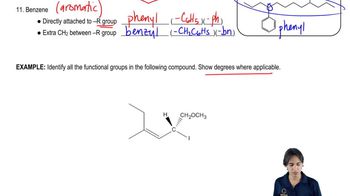
Nucleophiles and Electrophiles can react in Substitution Reactions.

Functional Group Transformation

Functional group transformation involves converting one functional group into another, which is essential in organic synthesis. In the case of muscalure, starting from 1-bromopentane, you may need to transform alkyl halides into alcohols or other functional groups that can be further modified. This concept is vital for understanding how to manipulate the molecular structure to achieve the desired compound.
Video consigliato:
02:36
Identifying Functional Groups

Stereochemistry

Stereochemistry refers to the study of the spatial arrangement of atoms in molecules and how this affects their chemical behavior. Muscalure has specific stereochemical requirements for its biological activity as a pheromone. When synthesizing muscalure from 1-bromopentane, it is important to consider the stereochemical outcomes of reactions to ensure that the correct isomer is produced, as different isomers can have vastly different effects.
Video consigliato:
Percorso guidato
1:38
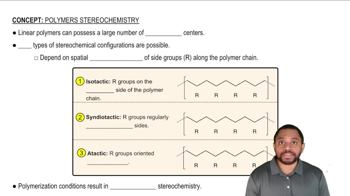
Polymer Stereochemistry Concept 1