Ch. 12 - Radicals
Bruice - Organic Chemistry 8th Edition
Bruice8th EditionOrganic ChemistryISBN: 9780135213711Non è quello che usi tu?Cambia libro di testo
Capitolo 12, Problema 26c

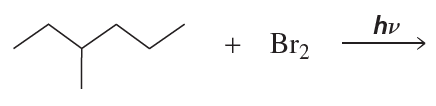
What are the product(s) of each of the following reactions? Disregard stereoisomers.
c. Chemical reaction showing an alkene reacting with bromine under light to form products.

Guida verificata passo dopo passo
1
Step 1: Recognize the type of reaction. The presence of Br₂ and light (hν) indicates a free radical halogenation reaction, specifically bromination.
Step 2: Identify the substrate. The given molecule is 2-methylbutane, a branched alkane.
Step 3: Determine the most reactive hydrogen for bromination. Bromine prefers to react with the hydrogen attached to the most substituted carbon due to the stability of the resulting radical. In this case, the tertiary carbon (the central carbon in the molecule) is the most substituted.
Step 4: Predict the product. Bromine will replace the hydrogen on the tertiary carbon, forming 2-bromo-2-methylbutane as the major product.
Step 5: Note that minor products may form due to bromination at other positions, but the major product is determined by the stability of the intermediate radical.

Risposta video verificata per un problema simile:

Questa soluzione video è stata consigliata dai nostri tutor come utile per risolvere questo problema.
Durata del video:
1m

Concetti chiave

Ecco i concetti essenziali che devi comprendere per rispondere correttamente alla domanda.

Free Radical Halogenation

Free radical halogenation is a reaction where alkenes react with halogens (like Br2) in the presence of light (hν) to form alkyl halides. The process involves the generation of free radicals, which are highly reactive species with unpaired electrons. The reaction typically proceeds through initiation, propagation, and termination steps, leading to the substitution of hydrogen atoms in the alkene with halogen atoms.
Video consigliato:
12:11
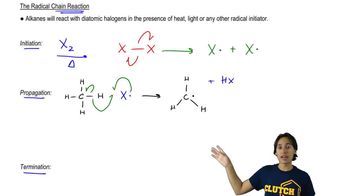
Radical Chain Reaction Mechanism.

Mechanism of Radical Reactions

The mechanism of radical reactions involves several key steps: initiation (where radicals are formed), propagation (where radicals react with stable molecules to form new radicals), and termination (where radicals combine to form stable products). In the case of bromination, the bromine molecule dissociates into two bromine radicals, which then react with the alkene to form bromoalkanes. Understanding this mechanism is crucial for predicting the products of the reaction.
Video consigliato:
12:11
Radical Chain Reaction Mechanism.

Regioselectivity in Electrophilic Addition

Regioselectivity refers to the preference of a chemical reaction to yield one structural isomer over others when multiple products are possible. In the context of alkene bromination, the regioselectivity is influenced by the stability of the radical intermediates formed during the reaction. The more stable radical will lead to the major product, which is often determined by the degree of substitution of the carbon atom where the bromine adds.
Video consigliato:
09:23
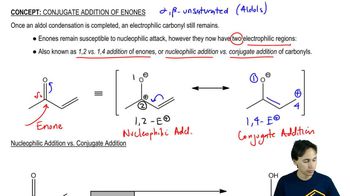
1,2 vs 1,4 Addition