
When 2-methylpropane is monochlorinated in the presence of light at room temperature, 36% of the product is 2-chloro-2-methylpropane and 64% is 1-chloro-2-methylpropane. From these data, calculate how much easier it is to remove a hydrogen atom from a tertiary carbon than from a primary carbon under these conditions.
Ch. 12 - Radicals
Capitolo 12, Problema 31d
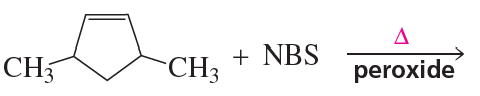
What is the major product of the following reactions? Disregard stereoisomers:
d. 
Guida verificata passo dopo passo1
Step 1: Recognize the reagent and reaction conditions. NBS (N-Bromosuccinimide) in the presence of heat (Δ) and peroxide is used for allylic bromination. This reaction selectively replaces a hydrogen atom at the allylic position with a bromine atom.
Step 2: Identify the allylic positions in the given molecule. The molecule is a substituted cyclohexene with two methyl groups. The allylic positions are the carbon atoms adjacent to the double bond.
Step 3: Determine the most reactive allylic position. The allylic position with the most stable radical intermediate will be favored. In this case, the allylic position adjacent to the methyl group is more stable due to hyperconjugation and inductive effects.
Step 4: Predict the major product. Bromine will replace the hydrogen atom at the most reactive allylic position, resulting in the formation of an allylic bromide.
Step 5: Disregard stereoisomers as instructed. The major product will be the allylic bromide formed at the most stable allylic position, without considering stereochemistry.

Risposta video verificata per un problema simile:
Questa soluzione video è stata consigliata dai nostri tutor come utile per risolvere questo problema.
Durata del video:
5mConcetti chiave
Ecco i concetti essenziali che devi comprendere per rispondere correttamente alla domanda.
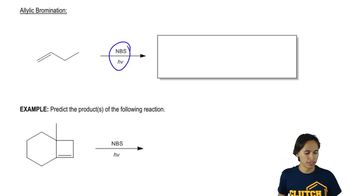
Allylic Bromination
Allylic bromination is a reaction where bromine is introduced at the allylic position of an alkene or alkane. This process typically involves the use of N-bromosuccinimide (NBS) in the presence of a radical initiator, such as peroxide, under heat. The reaction proceeds via a radical mechanism, where the allylic hydrogen is abstracted, forming a resonance-stabilized radical that can then react with bromine.
Video consigliato:
Mechanism of Allylic Bromination.
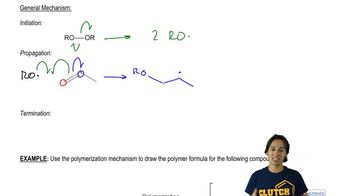
Radical Mechanism
A radical mechanism involves the formation and reaction of free radicals, which are highly reactive species with unpaired electrons. In the context of allylic bromination, the reaction begins with the generation of radicals through the homolytic cleavage of the N–Br bond in NBS, followed by the abstraction of hydrogen from the allylic position. This mechanism is crucial for understanding how the product distribution is influenced by the stability of the resulting radicals.
Video consigliato:
The mechanism of Radical Polymerization.
Regioselectivity
Regioselectivity refers to the preference of a chemical reaction to yield one structural isomer over others when multiple possibilities exist. In allylic bromination, the stability of the radical intermediates determines the major product. More stable radicals, such as those formed at more substituted allylic positions, are favored, leading to a specific major product in the reaction. Understanding regioselectivity is essential for predicting the outcome of the reaction.
Video consigliato:
Heck Reaction
Pratica correlata
Domanda del libro di testo
2472
views
Domanda del libro di testo
Propose a mechanism to account for the products formed in the following reaction:
958
views
Domanda del libro di testo
What is the major product of the following reactions? Disregard stereoisomers:
a.
822
views
Domanda del libro di testo
The deuterium kinetic isotope effect for the halogenation of an alkane is defined in the following equation, where X・ = Cl・ or Br・
Predict whether chlorination or bromination would have a greater deuterium kinetic isotope effect.
1215
views
Domanda del libro di testo
What is the major product of the following reactions? Disregard stereoisomers:
b.
998
views
Domanda del libro di testo
What is the major product of the following reactions? Disregard stereoisomers:
c.
1411
views
