Ch. 14 - NMR Spectroscopy
Bruice - Organic Chemistry 8th Edition
Bruice8th EditionOrganic ChemistryISBN: 9780135213711Non è quello che usi tu?Cambia libro di testo
Capitolo 14, Problema 28b

Describe the 1H NMR spectrum you would expect for each of the following compounds, indicating the relative positions of the signals:
b. CH3OCH2CH2CH2Br

Guida verificata passo dopo passo
1
Identify the structure of the compound in question. Analyze the molecular structure to determine the number of unique hydrogen environments. Each unique environment corresponds to a distinct signal in the 1H NMR spectrum.
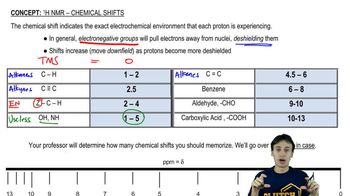
Determine the chemical shift range for each type of hydrogen based on its electronic environment. For example, hydrogens attached to sp3 carbons (alkyl groups) typically appear between 0-3 ppm, while hydrogens on sp2 carbons (alkenes or aromatic rings) appear between 4-8 ppm. Consider the effects of electronegative groups or π-systems nearby.
Analyze the splitting pattern for each signal. The splitting is determined by the number of neighboring hydrogens (n) using the n+1 rule. For example, a hydrogen with two neighboring hydrogens will show a triplet.
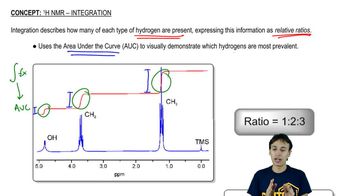
Determine the relative integration of each signal. The integration corresponds to the number of hydrogens contributing to that signal. For example, a CH3 group will have an integration of 3, while a CH2 group will have an integration of 2.
Combine all the information to describe the expected 1H NMR spectrum. Include the number of signals, their approximate chemical shifts, splitting patterns, and relative integrations. This will provide a complete picture of the spectrum for the compound.

Risposta video verificata per un problema simile:

Questa soluzione video è stata consigliata dai nostri tutor come utile per risolvere questo problema.
Durata del video:
4m

Concetti chiave

Ecco i concetti essenziali che devi comprendere per rispondere correttamente alla domanda.

1H NMR Spectroscopy

1H NMR (Proton Nuclear Magnetic Resonance) spectroscopy is a powerful analytical technique used to determine the structure of organic compounds. It provides information about the number of hydrogen atoms in different environments within a molecule, allowing chemists to infer connectivity and functional groups. The resulting spectrum displays peaks corresponding to different hydrogen environments, with their positions (chemical shifts) indicating the electronic environment around the protons.
Video consigliato:
06:46
1H NMR Integration

Chemical Shift

Chemical shift refers to the position of a signal in an NMR spectrum, measured in parts per million (ppm). It reflects the electronic environment surrounding the hydrogen atoms; for example, protons near electronegative atoms (like oxygen or nitrogen) typically resonate at lower fields (higher ppm). Understanding chemical shifts is crucial for interpreting the spectrum, as they help identify functional groups and the overall structure of the compound.
Video consigliato:
11:44
1H NMR Chemical Shifts

Integration and Multiplicity

Integration in 1H NMR refers to the area under each peak, which correlates to the number of protons contributing to that signal. Multiplicity indicates the splitting pattern of the peaks, which arises from neighboring hydrogen atoms (n+1 rule). Together, integration and multiplicity provide insights into the number of hydrogen atoms in a particular environment and their connectivity, aiding in the elucidation of the compound's structure.
Video consigliato:
06:46
1H NMR Integration