Ch. 15 - Reactions of Carboxylic Acids and Carboxylic Acid Derivatives
Bruice - Organic Chemistry 8th Edition
Bruice8th EditionOrganic ChemistryISBN: 9780135213711Non è quello che usi tu?Cambia libro di testo
Capitolo 15, Problema 63(9,10)

a. Which of the following reactions does not give the carbonyl product shown?
b. Which of the reactions that do not occur can be made to occur if an acid catalyst is added to the reaction mixture?
9. Chemical reaction diagram showing nucleophilic acyl substitution with reactants and product labeled.
10. Chemical reaction diagram showing the reaction of two carbonyl compounds with methanol to form an ester.

Guida verificata passo dopo passo
1
Step 1: Analyze the reactions provided in the image. Reaction 1 involves the conversion of an amide to an acyl chloride using Cl⁻. Reaction 2 involves the hydrolysis of an amide to form a carboxylic acid using H₂O. Reaction 3 involves the reaction of an acyl chloride with an enolate to form a β-keto ester.
Step 2: Determine which reactions produce the carbonyl product shown. Reaction 1 produces an acyl chloride, Reaction 2 produces a carboxylic acid, and Reaction 3 produces a β-keto ester. Compare these products to the carbonyl product in question.
Step 3: Identify the reactions that do not occur under the given conditions. Reaction 2 (amide hydrolysis) typically requires an acid or base catalyst to proceed efficiently. Without a catalyst, this reaction may not occur.
Step 4: Consider how the reactions that do not occur can be made to occur. For Reaction 2, adding an acid catalyst (e.g., HCl) would protonate the amide, making it more susceptible to nucleophilic attack by water, thereby facilitating hydrolysis to form the carboxylic acid.
Step 5: Summarize the findings. Reaction 2 does not occur without a catalyst but can be made to occur with the addition of an acid catalyst. Reaction 1 and Reaction 3 proceed under the given conditions and produce their respective carbonyl products.

Risposta video verificata per un problema simile:

Questa soluzione video è stata consigliata dai nostri tutor come utile per risolvere questo problema.
Durata del video:
6m

Concetti chiave

Ecco i concetti essenziali che devi comprendere per rispondere correttamente alla domanda.

Nucleophilic Acyl Substitution

Nucleophilic acyl substitution is a fundamental reaction mechanism in organic chemistry where a nucleophile attacks the carbonyl carbon of a carboxylic acid derivative, leading to the substitution of a leaving group. This mechanism is crucial for understanding how different carboxylic acid derivatives, such as esters, amides, and acyl chlorides, react to form carbonyl products. The reaction typically involves the formation of a tetrahedral intermediate, which then collapses to release the leaving group.
Video consigliato:
01:47
Nucleophiles and Electrophiles can react in Substitution Reactions.

Role of Acid Catalysts

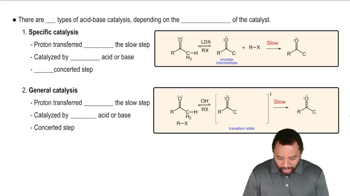
Acid catalysts play a significant role in enhancing the reactivity of nucleophilic acyl substitution reactions. They can protonate the carbonyl oxygen, increasing the electrophilicity of the carbonyl carbon, making it more susceptible to nucleophilic attack. This is particularly important in reactions that may not proceed efficiently under neutral conditions, allowing for reactions that would otherwise be unfavorable to occur more readily.
Video consigliato:
Percorso guidato
2:50
Acid-Base Catalysis Concept 3

Carboxylic Acid Derivatives

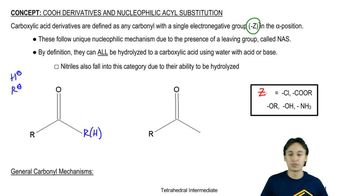
Carboxylic acid derivatives include compounds like acyl chlorides, esters, and amides, which differ in their leaving groups and reactivity. Understanding the structure and reactivity of these derivatives is essential for predicting the outcomes of nucleophilic acyl substitution reactions. Each type of derivative has unique characteristics that influence how they react with nucleophiles and the types of products formed, which is critical for answering questions about specific reaction pathways.
Video consigliato:
03:50
Intro to Carboxylic Acid Derivatives